
Queen Mary University of London University of Cambridge

An Analysis of the Primary Microstructure of Cr and Mo Containing Low-Alloy Steel Welds

Proceedings of the 4th Scandanavian Symposium on Materials Science, Norwegian Institute of Technology, Norway. August 25-26, 1986, pp. 153-158, by H.K.D.H. Bhadeshia, L.-E. Svensson and B. Gretoft

Weld metal strength can be increased by alloying with Cr and Mo, without unduly sacrificing toughness. In this work we report theoretical and experimental work on the design of Cr and Mo containing welding consumables.

This research paper investigates how chromium and molybdenum impact the primary microstructure and mechanical properties of low-alloy steel welds. The authors utilise a theoretical model to predict the formation of various ferrite phases, comparing these mathematical calculations against experimental data obtained from manual-metal-arc welding.

A key finding is that the addition of these elements appears to lower the nucleation rate of Widmanstätten ferrite, necessitating specific adjustments to the predictive model for better accuracy. While the strength and toughness of the resulting welds remained within acceptable limits, the study suggests caution when using high concentrations of molybdenum for low-temperature applications.

Ultimately, the work demonstrates that phase transformation theory can be effectively applied to the computational design of specialised welding consumables.

Download publication

Audio podcastAudio podcast

Analysis of the Primary Microstructure of Cr and Mo Containing Low-Alloy Steels: Study Guide

This study guide provides a comprehensive review of the research regarding the microstructural development and mechanical properties of weld metals alloyed with chromium (Cr) and molybdenum (Mo).

Part 1: Short-answer quiz

Instructions: Answer the following questions in two to three sentences based on the provided research text.

  1. What is the primary objective of incorporating chromium (Cr) and molybdenum (Mo) into weld metal consumables?
  2. How is the initial structure of columnar austenite (γ) represented in the study's model?
  3. Describe the transformation that occurs at the temperature designated as Th.
  4. What are "microphases" and how do they form within the weld metal?
  5. Explain the difference between the two 'C' curves found in the time-temperature-transformation (TTT) diagram.
  6. What is the significance of the temperature T1 in the phase transformation process?
  7. What experimental welding parameters were used to deposit the weld metals for analysis?
  8. How did the initial theoretical model perform regarding the volume fraction of Widmanstätten ferrite (vw), and how was it corrected?
  9. According to the mechanical properties data, what is the impact of low temperatures on Charpy toughness?
  10. What conclusion did the researchers reach regarding the use of high concentrations of molybdenum for service at −60°C?

Part 2: Answer key

1. Objective The primary goal is to increase the strength of the weld metal through alloying with Cr and Mo. This is intended to be achieved without causing an undue sacrifice in the toughness of the material. 2. Austenite representation The columnar austenite grain structure is represented as a honeycomb of hexagonal prisms. Each prism is defined by a side length 'a' and a length 'c', where 'c' is much greater than 'a'. 3. Transformation at Th At the temperature Th, the austenite begins to transform into layers of allotriomorphic ferrite (α). This process occurs through a diffusional transformation mechanism at the austenite grain boundaries (γ/γ). 4. Microphases Microphases are the small volume fractions of remaining austenite that eventually decompose into degenerate pearlite or mixtures of martensite and retained austenite. They represent the final stage of the transformation process after the formation of acicular ferrite. 5. TTT curves The upper 'C' curve indicates the time required for the isothermal initiation of diffusional transformations, such as allotriomorphic ferrite and pearlite. The lower 'C' curve represents the initiation times for displacive transformations, including Widmanstätten ferrite and acicular ferrite. 6. Significance of T1 T1 is the crossover point of the two 'C' curves on the TTT diagram. Below this temperature, displacive transformations are assumed to be kinetically favoured, meaning the growth of allotriomorphic ferrite ceases in favour of Widmanstätten and acicular ferrite. 7. Welding parameters Welds were deposited using manual metal arc (MMA) welding with 4mm diameter electrodes and an ISO2560 joint design. The process utilised 170A, 21V DC+, a welding speed of 4mm/s, and an interpass temperature of 250°C. 8. Model correction The initial model consistently overestimated the volume fraction of Widmanstätten ferrite (vw). To improve agreement with experimental data, the researchers reduced the calculated nucleation rate of αw by a factor of 0.289. 9. Temperature and toughness The data indicates that Charpy toughness significantly decreases as the testing temperature drops. For instance, in Weld 2, the toughness falls from 213 Joules at 20°C to 38 Joules at −60°C. 10. Mo for low-temperature service The study suggests that for service at −60°C, it may be advisable to avoid high concentrations of molybdenum. This is because the microstructural differences between the welds are small, and toughness values can be quite low at that specific temperature.

Part 3: Essay questions

Instructions: Use the data and theoretical frameworks provided in the source context to develop comprehensive responses to the following prompts.


Part 4: Glossary of key terms

Term Definition
Acicular Ferrite (αa) A phase that nucleates on inclusions and grows within austenite grains via a displacive transformation mechanism.
Allotriomorphic Ferrite (α) Ferrite that forms at the prior austenite grain boundaries during the initial stages of cooling through a diffusional mechanism.
Displacive Transformation A phase change that occurs through the coordinated movement of atoms rather than long-range diffusion.
Hard Impingement A condition where the growth of a phase (like Widmanstätten ferrite) is physically terminated by contact with another phase.
Paraequilibrium A state where growth occurs while only interstitial atoms (like carbon) reach equilibrium, while substitutional atoms (like Cr or Mo) remain immobile.
T1 The temperature at which the initiation of displacive transformations becomes more kinetically favoured than diffusional transformations.
Widmanstätten Ferrite (αw) A phase that nucleates at the boundaries between allotriomorphic ferrite and austenite, growing into the austenite grains as thin plates.
Pearlite in steels
Published 2025
Audio summaries
Steels 5th edition Published 2024
Bainite 3rd edition Free download
Crystallography 1st edition Free download Audio, video summaries
Bainite at play Published 2026 video
Theory of transformations in steels Free download
Functional Materials Free book Hard copy
Phase transitions
Free book,
source (CC-BY)
Isolation Free download
rail steels
Rails, 2024
Audio summary
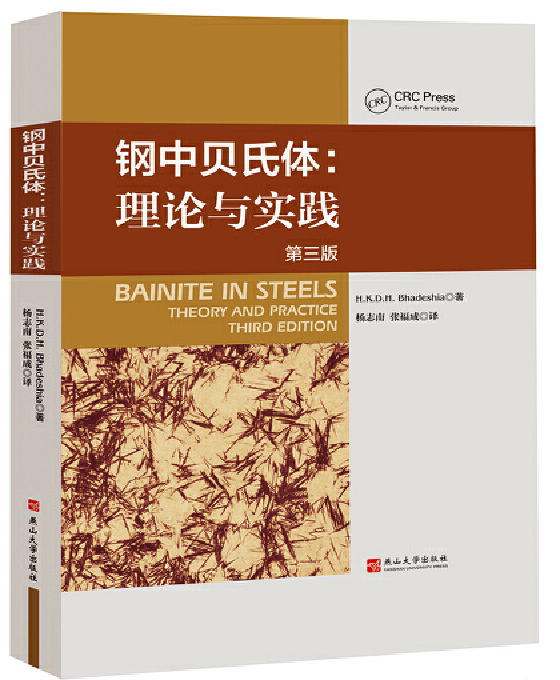
Bainite in Steels, Chinese edition Translation, 2020
Innovations in everyday engineering materials
Published 2021