Interactive study guide
H. K. D. H. Bhadeshia
Instructions: Read the prompt and try to outline an answer. Click "Show Hints" to see the critical concepts and keywords that should be included in your response.
Discuss how defining symmetry elements (monads, diads, triads, tetrads, and hexads) are used to categorise the seven crystal systems. Explain why a specific symmetry requirement is considered the "minimum" for a system.
Compare the service life and mechanical behaviour of single-crystal turbine blades versus polycrystalline blades. Reference the role of grain boundaries and atom movement.
Explore the various dimensions in which crystals can exist (2D, 3D, and 4D). Include a discussion on the theoretical challenges of "time crystals."
Explain the mathematical relationship between basis vectors, unit cells, and the infinite lattice. Contrast primitive representations with non-primitive unit cells.
Analyse how the internal atomic arrangement of a crystal dictates its physical response to external factors, such as applied stress or inter-atomic spacing.
Advanced Study Guide & Challenge Modules
Prove the Crystallographic Restriction Theorem using a linear row of lattice points and rotational operations.
1. Imagine a row of lattice points A, B, C... separated by a translation vector a.
2. If an n-fold rotation axis exists at each point, rotating AB by an angle α = 2π/n clockwise around B and anticlockwise around A must produce two new lattice points, A' and B'.
3. The vector connecting A' and B' must be a multiple of the original translation vector a to maintain periodicity. Therefore:
4. Simplifying this gives the condition for allowed rotations:
5. Since cos(α) must fall between -1 and 1, the value M = (m - 1) can only be an integer from -2 to 2. Let's test n = 5:
6. Plugging this into our equation: 0.309 = M / 2 implies M = 0.618. Since 0.618 is not an integer, 5-fold symmetry cannot exist in a periodic lattice.
Conclusion: Only rotations where cos(α) yields an integer/half-integer result (1, 2, 3, 4, 6-fold) are allowed.The book mentioned quasicrystals. Quasicrystals actually do exhibit 5-fold, 8-fold, or 10-fold symmetry. However, they are aperiodic, meaning they have order but do not have the repeating translation vector a that defines the 14 Bravais lattices. This mathematical proof is the reason why quasicrystals were considered "impossible" until Dan Shechtman's discovery in 1982.
| Fold (n) | Angle (α) | cos(α) | Allowed? |
|---|---|---|---|
| 1 | 360° | 1 | Yes (Monad) |
| 2 | 180° | -1 | Yes (Diad) |
| 3 | 120° | -0.5 | Yes (Triad) |
| 4 | 90° | 0 | Yes (Tetrad) |
| 5 | 72° | 0.309 | No |
| 6 | 60° | 0.5 | Yes (Hexad) |
Primitive vectors for the FCC lattice connect the corner to the face centres:
| Property | Cubic-F | Primitive |
|---|---|---|
| Points | 4 | 1 |
| Volume | a3 | a3/4 |
| Angles | 90° | 60° |
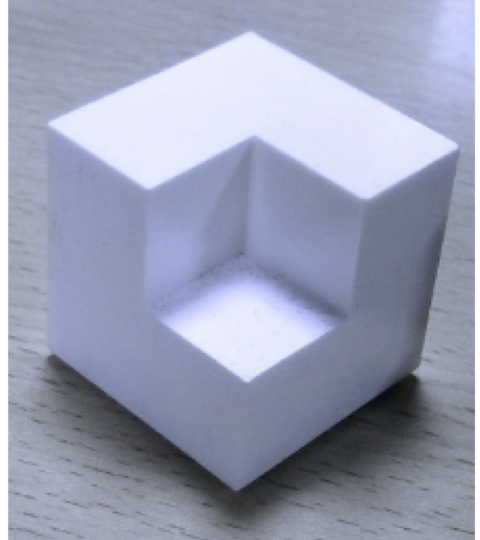
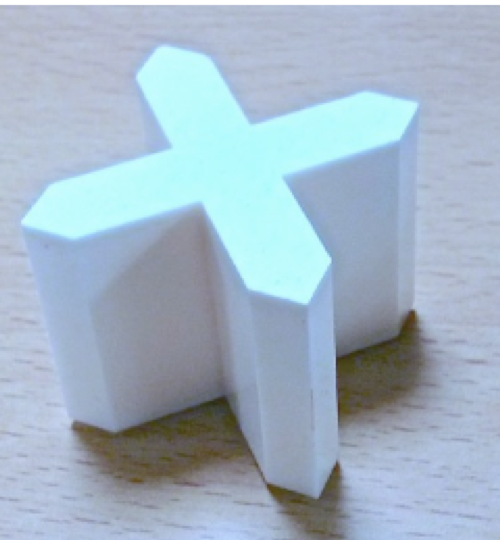
Analyse the symmetry elements of the two objects to determine their point groups.
| Term | Definition |
|---|---|
| Amorphous Solid | A homogeneous, isotropic solid lacking long-range order or periodicity in its atomic arrangement. |
| Anisotropy | The characteristic of a material where its physical properties vary depending on the direction or orientation. |
| Basis Vectors | Three non-coplanar vectors (a1, a2, a3) that define the edges of a unit cell. |
| Bravais Lattices | The fourteen unique ways in which points can be arranged regularly in three dimensions to fill space. |
| Miller Indices | The set of components [u1 u2 u3] of a vector representing a direction within a lattice. |
| Polycrystalline | A material consisting of a space-filling aggregate of many individual crystals of varying sizes and orientations. |