Bainite and twin-roll-strip casting
1. Introduction
An exciting set of experimental observations has recently been published by Li et al. in the Journal of Materials Research and Technology 43 (2026) 2925, exploring the "Effect of silicon on phase transformation kinetics and austenite stabilisation under twin-roll-strip-casting-relevant cooling and simulated coiling conditions."
For a high-silicon steel with a chemical composition of Fe-0.25C-2Si-2Mn-0.25Cr wt% containing a bainitic microstructure, the authors reported precise measurements of carbon concentrations in the retained austenite (wCγ) as a function of the isothermal transformation temperature. These measurements were obtained using high-resolution X-ray diffraction.

2. Measurements
The extracted quantitative datasets below show both the weight percentage (wCγ) and the corresponding calculated mole fraction (xCγ) of carbon in the austenite phase, complete with lower and upper experimental error bounds.
Table 1: Measurements of wCγ (wt%) using X-ray diffraction
| Transformation temperature (°C) | wCγ (wt%) | Lower error bound | Upper error bound |
|---|---|---|---|
| 280 | 1.25 | 1.18 | 1.32 |
| 290 | 1.18 | 1.08 | 1.28 |
| 300 | 1.04 | 0.99 | 1.09 |
| 310 | 0.89 | 0.80 | 0.98 |
Table 2: Measurements of xCγ (mole fraction) using X-ray diffraction
| Transformation temperature (°C) | xCγ (mole fraction) | Lower error bound | Upper error bound |
|---|---|---|---|
| 280 | 0.0545 | 0.0516 | 0.0574 |
| 290 | 0.0516 | 0.0474 | 0.0558 |
| 300 | 0.0457 | 0.0436 | 0.0478 |
| 310 | 0.0393 | 0.0354 | 0.0431 |
3. Thermodynamic interpretation
These measured carbon concentrations provide crucial insights into interpreting the core thermodynamics governing the bainite transformation mechanism.
If the transformation involves a diffusionless mechanism where carbon remains temporarily dissolved in the remaining austenite, the bainite reaction must cease as soon as the carbon concentration in the austenite hits the thermodynamic T0 condition. The T0 curve defines the boundary where the free energy of austenite and ferrite of identical composition are equal. This sets a hard limit on the maximum carbon concentration achievable in austenite transforming without a compositional shift, meaning the newly formed phase inherits the exact composition of the parent austenite.
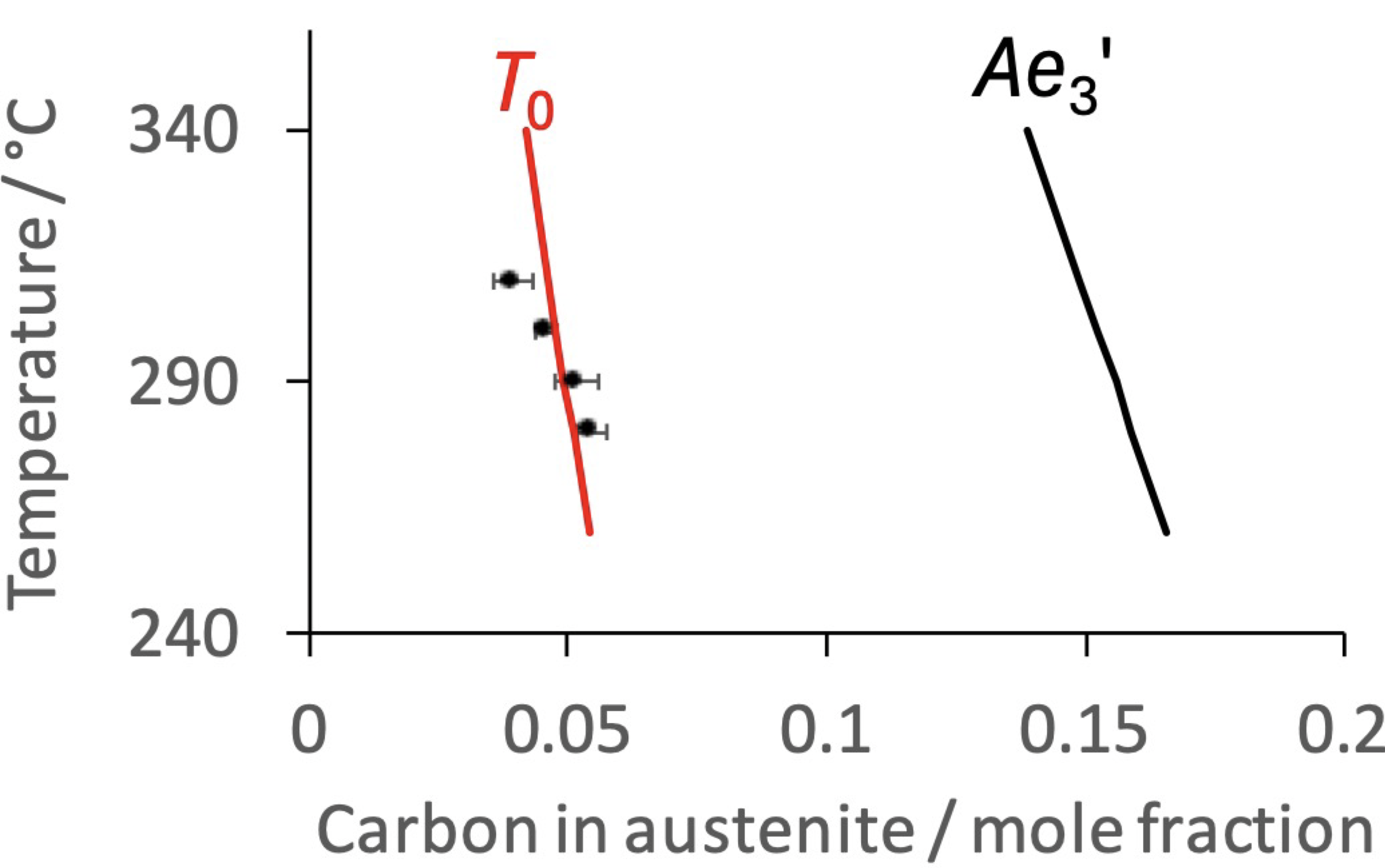
As illustrated in Figure 1, comparing the experimental datasets published by Li et al. against the calculated thermodynamic curves yields an outstanding agreement with the T0 condition. Conversely, the experimental points remain far removed from the paraequilibrium Ae3′ curve.
This fundamental divergence from the Ae3′ line provides compelling evidence that the transformation to bainite is diffusionless, with excess carbon partitioning out into the residual austenite only following the initial growth phase.
4. Tools and methodology
The thermodynamic calculations presented here were performed using the freely available MUCG46 software package [1]. For researchers interested in running their own simulations, this tool can be accessed via the interactive online portal: MUCG TTT Calculator.
Further comprehensive insights and a deeper scientific exploration of this topic can be found in the recent critical assessment published in 2026 [2].
References
- H. K. D. H. Bhadeshia: 'Software for transformations in steels': MUCG46 Program Archive, 1982.
- H. K. D. H. Bhadeshia: 'Mechanism of the bainite transformation: A turning point', Metallurgical & Materials Transactions A, 2026, 57, 1–20.