

A long-standing point of discussion in physical metallurgy is how phase transformation kinetics change when moving across key thermal thresholds. A classic example is exploring what happens when the bainite reaction is forced to take place below the traditional martensite-start temperature (MS).
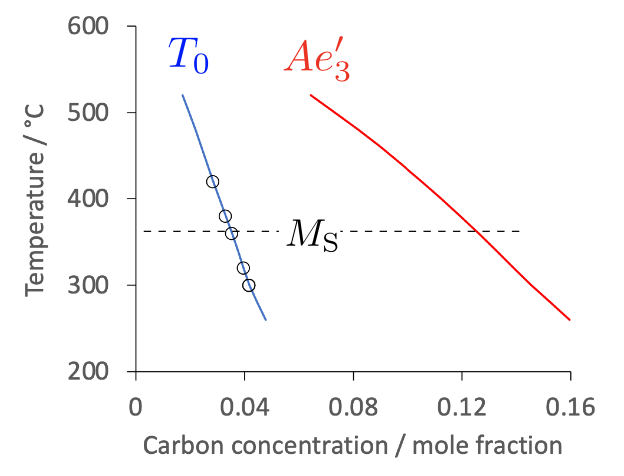
Recent research confirms that even when bainite forms below the MS temperature, the thermodynamic rules governing the transformation remain remarkably resilient. Specifically, the terminal carbon concentration of the residual austenite cannot exceed the T0 phase boundary limit. At this boundary, the free energies of the ferrite and austenite phases of identical composition become equal, acting as a strict barrier to further displacive growth.
Thermodynamic consistency: It is evident that the formation of bainite below MS is not fundamentally different from a thermodynamic perspective. The incomplete reaction phenomenon still dictates the limits of phase transformation.
This thermodynamic consistency is clearly illustrated by experimental data gathered from a high-strength alloy steel (Fe–0.25C–1.68Si–1.82Mn–1.45Cr–0.27Ni–0.054V wt%). By using either direct isothermal holding or a distinct two-step heat treatment involving supercooling below the MS point, carbide-free bainite was successfully generated within a pre-existing martensitic matrix.
Microstructural consequences of low-temperature undercooling
While the overall thermodynamic framework remains unaltered, shifting the transformation below the MS threshold drastically scales the structural dimensions of the final microstructural features:
- Refined scale: As expected from governing thermodynamic models (such as plate thickness scaling equations), the physical size and scale of individual bainite plates systematically contract as the operating transformation temperature drops; a trend mirrored in parallel by a shrinking overall sheaf thickness.
- Austenite volume reduction: The total remaining volume fraction and physical size of blocky or film-type retained austenite are heavily reduced compared to standard configurations processed entirely above the MS point. This happens because the initial burst of athermal martensite formation combined with subsequent lower-temperature bainite growth rapidly consumes the bulk of the initial parent austenite phase.
- Carbon scaling: Despite this reduced spatial presence, the total localized carbon concentration within these thin film networks increases dramatically, tracking perfectly along the steep negative slope of the stable T0 thermodynamic curve.
- Dislocation densities: Finally, due to the high mechanical resistance to plastic accommodation at lower processing temperatures, the defect and dislocation density within the resulting bainitic ferrite matrix increases significantly.