It has been known since Johnson's discovery [Proceedings of the Royal Society of London 23 (1875) 168], that hydrogen embrittles iron. However, tracking exactly how hydrogen penetrates and moves through these metallic structures has remained a challenge. A breakthrough study by Aksoy et al. (2026) provides a fresh perspective by enabling the direct visualisation of hydrogen penetration into martensitic steel, as a function of time.
An "operando" approach via synchrotron X-rays
To achieve this, the researchers utilised an operando analytical technique. In this context, operando refers to a method that measures and observes a material in real time and non-destructively while a dynamic process is actively occurring.
The crucial difference: in situ means "in the original place", not necessarily measuring active output. Operando implies active monitoring in so-called real time. The word is from the Latin verb meaning "to work"", "to labour", or "to operate".
The high-energy X-ray source required for this rapid data collection was provided by a synchrotron, ensuring emissions have sufficient energy to enable dynamic data collection. During each experimental cycle, the sample was scanned vertically in a serpentine pattern, using 5 μm steps across a 1 mm lateral section of the specimen. While the exact numerical frequency or time interval for gathering the diffraction data is not explicitly stated in the paper, the resulting diffraction patterns successfully characterised local lattice parameters. Because the partial molar volume of hydrogen in iron is the largest among all transition metal elements with the exception of molybdenum [R. Griessen, Physical Review B 38 (1988) 3690], the location of hydrogen can be accurately mapped based entirely on these induced lattice strains.
Trapping microstructures: precipitate-free vs. tempered steel
The core findings of the paper echo a classic concept proposed by Darken and Smith [Corrosion 5 (1949) 1]. They were the first to suggest that the apparent diffusivity of hydrogen changes when a fraction of it becomes caught in traps within the imperfections of the iron lattice, drawing an elegant analogy at the time with the diffusion of oxygen into copper containing silicon. They quantitatively observed that the saturation concentration of hydrogen was notably smaller for hot-rolled steel than for steel that had been plastically deformed, owing to hydrogen trapping at deformation defects.
Investigating an alloy composition (Fe-6Ni-5Cr-2.2Al-0.7Mo-0.5V-0.3Mn-0.1Si-0.2C wt%), Aksoy et al. arrived at a similar conclusion regarding microstructural control:
1. Precipitate-free martensite
In the precipitate-free state, hydrogen transport is heavily dominated by fast lattice diffusion, which allows it to distribute almost homogeneously throughout the material. The effective diffusivity in this condition was measured to be approximately:
2. Precipitation-rich (tempered) microstructure
In contrast, in the precipitation-rich microstructure containing carbides and nickel-rich aluminides, the particles behave as both reversible and "irreversible" traps. This dense network of traps suppresses the effective diffusivity by more than an order of magnitude, dropping it down to roughly:
This trapping mechanism confines the hydrogen tightly to near-surface regions, significantly retarding its capacity to penetrate into the bulk material. Ultimately, by capturing mobile hydrogen and locking it into a trapped state, the tiny precipitates suppress long-range hydrogen transport, effectively delaying material degradation via hydrogen embrittlement.
Comments
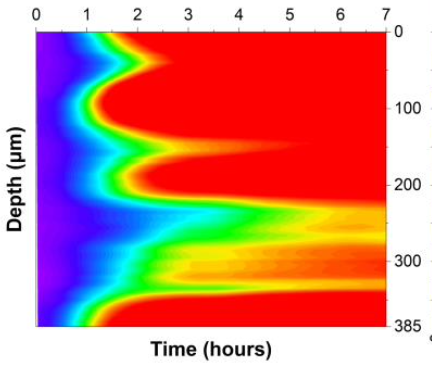
Despite the clarity of the mapping technique, some anomalies remain. Notably, the precipitate-free sample exhibited a highly heterogeneous strain field, as illustrated in the depth-versus-time plot above. While the paper characterises this distribution as "nearly homogeneous", the variation seems large. Is there something to be discovered here, for example by looking at the microstructure across the depth to see why the penetration is reduced at about 250 micrometres?
The text includes brief mentions of the so-called hydrogen-enhanced localised plasticity and hydrogen-enhanced decohesion models for embrittlement. However, the specific experiments reported offer no concrete evidence for either, so this short discussion is not relevant to the interpretation of the experimental data presented.
