Queen Mary University of London University of Cambridge

Computer-Aided Design of Electrodes for Manual Metal Arc Welding

Proceedings of an International Conference on Computer Technology in Welding, 1986, editor W. Lucas, published by The Welding Institute, Abington, U.K., pp. 113-122, L.-E. Svensson, B. Gretoft and H. K. D. H. Bhadeshia

Manual metal arc welding is a complex process involving many variables. In this work we report the development of computer software, based on detailed phase-transformation theory. This allows the theoretical design of primary weld microstructures as a function of the chemical composition, welding current, voltage, arc transfer efficiency, interpass temperature, joint geometry and solidification structure. The application of the software is discussed in terms of electrodes for use in the off-shore oil industry.

This research paper examines the microstructural development of acicular ferrite within steel weld deposits to better understand its growth mechanism. Through crystallographic measurements and thermodynamic analysis, the authors demonstrate that this ferrite forms via a diffusionless, displactive transformation rather than a ledge mechanism.

The study utilises electron microscopy and surface relief experiments to show that acicular ferrite grows as non-parallel, lenticular plates nucleated on inclusions. These findings indicate that the transformation involves an atomic correspondence between the parent austenite and the resulting ferrite, accompanied by a significant invariant-plane strain.

Ultimately, the evidence suggests that acicular ferrite is essentially bainite that nucleates intragranularly. These results provide a clearer scientific basis for the improved toughness observed in welds containing these specific microstructures.


Download publication

Audio podcastAudio podcast

Study guide

Short-Answer Quiz

  1. What is the primary objective of the computer software described in the document? The software is designed to theoretically predict the primary weld microstructures of manual metal arc welds. It utilises detailed phase-transformation theory to model microstructure as a function of variables such as chemical composition, welding current, voltage, and cooling conditions.
  2. Which specific alloying elements are concentrated on in the theoretical design of these electrodes? While the models apply to various combinations of Mn, Si, Ni, Cr, Mo, V, and C, this specific study concentrates on the Fe-Mn-Ni-Si-C alloy system. The research specifically looks at varying Manganese and Nickel concentrations to achieve desired strength and toughness.
  3. Why are experimentally determined cooling curves necessary for the calculations? Cooling curves of the fusion zone cannot be predicted with sufficient accuracy through theoretical means alone. Because the γ (austenite) grain size and transformation sequences are highly sensitive to heat input, experimental measurement is required for accuracy.
  4. Describe the initial stages of solidification in low-alloy steel welds. Solidification begins with the epitaxial nucleation of δ-ferrite from the melt at the fusion boundary, followed by cellular growth. These δ grains then decompose into a columnar austenite (γ) grain structure, represented morphologically as a honeycomb of hexagonal prisms.
  5. What is allotriomorphic ferrite, and how does it grow? Allotriomorphic ferrite (α) is the first phase to form when austenite cools to a specific temperature (Th). It grows as layers at the γ/γ grain boundaries through a diffusional transformation mechanism controlled by the diffusion of carbon.
  6. How does Widmanstätten ferrite (αw) differ from allotriomorphic ferrite? Widmanstätten ferrite forms via a displacive transformation mechanism rather than purely diffusional. It nucleates at the α/γ boundaries and grows into the austenite grains at a rate controlled by the diffusion of carbon ahead of the plate tips.
  7. What role do inclusions play in the development of the weld microstructure? Inclusions serve as vital nucleation sites for acicular ferrite (αa) within the austenite grains. Their ability to nucleate acicular ferrite significantly influences the final volume fractions of the microstructure.
  8. How does the Time-Temperature-Transformation (TTT) diagram assist in these calculations? The TTT diagram consists of two "C" curves: the upper curve defines the kinetics for diffusional transformations (allotriomorphic ferrite), while the lower curve defines displacive transformations (Widmanstätten and acicular ferrite).
  9. What is the relationship between Nickel concentration and acicular ferrite content? The weld microstructure is more sensitive to Nickel at lower Manganese concentrations (~0.7 wt.%). As Nickel increases, the microstructural difference between low and high Manganese welds tends to decrease.
  10. What did the study conclude regarding electrode coating compositions? Type A electrodes led to slower weld cooling rates and higher γ grain sizes compared to Type B. This generally resulted in a higher acicular ferrite content for Type A, even when deposit compositions were nearly identical.

Answer Key

Subject Core Conclusion
ObjectiveTo theoretically design primary microstructures using software based on phase-transformation theory.
ElementsConcentrated on the Fe-Mn-Ni-Si-C system.
Cooling CurvesExperimental data is needed due to the sensitivity of austenite grain size to heat input and carbon levels.
Solidificationδ-ferrite nucleation → cellular growth → decomposition into columnar austenite hexagonal prisms.
TTT DiagramIdentifies temperature/time boundaries for diffusional (upper) and displacive (lower) curves.

Essay Questions

Glossary of Key Terms

Term Definition
Acicular Ferrite (αa) A microstructure nucleating on inclusions within austenite grains, forming thin plates that improve toughness.
Austenite (γ) A high-temperature phase of steel; in welding, it forms columnar grains that decompose into various ferrite types.
Displacive Transformation A phase change involving the coordinated movement of atoms (e.g., Widmanstätten ferrite), often controlled by carbon diffusion.
Microphases (vm) Small volume fractions of remaining austenite that decompose into pearlite, martensite, or retained austenite.
Partition Coefficient (ki) The ratio of the mole fraction of an alloying element in the solid phase to that in the liquid phase during solidification.
Pearlite in steels
Published 2025
Audio summaries
Steels 5th edition Published 2024
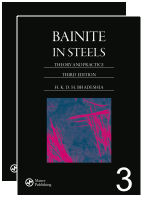
Bainite 3rd edition Free download
Crystallography 1st edition Free download Audio, video summaries
Bainite at play Published 2026 video
Theory of transformations in steels Free download
Functional Materials Free book Hard copy
Phase transitions
Free book,
source (CC-BY)
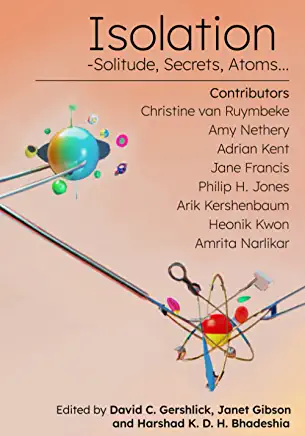
Isolation Free download
rail steels
Rails, 2024
Audio summary
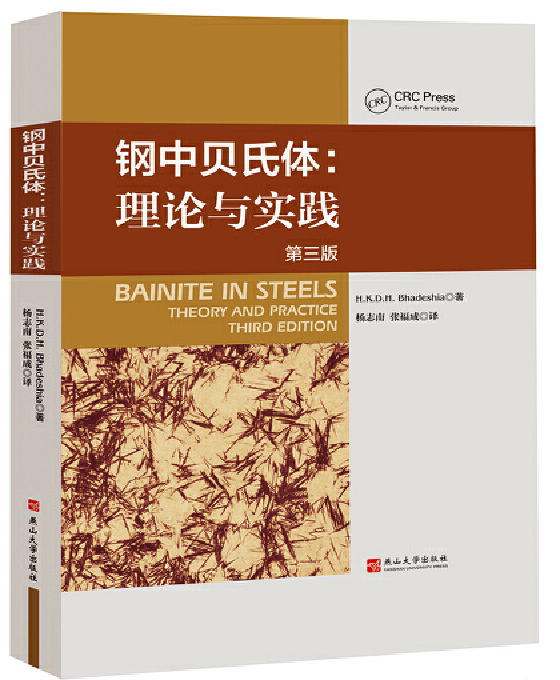
Bainite in Steels, Chinese edition Translation, 2020
Innovations in everyday engineering materials
Published 2021