The transition from upper to lower bainite


As the isothermal transformation temperature is reduced below BS , lower bainite is obtained in which carbides precipitate in the ferrite, with a correspondingly reduced amount of precipitation from the austenite between the ferrite. This transition from upper to lower bainite can be explained in terms of the rapid tempering processes that occur after the growth of a supersaturated plate of bainite. Excess carbon tends to partition into the residual austenite by diffusion, but the supersaturation may also be reduced by precipitation in the ferrite.

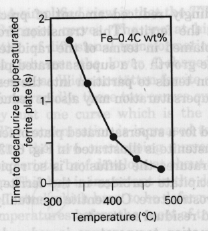
The time required for a supersaturated plate of ferrite to decarburise by diffusion into austenite is illustrated in Figure for a typical steel. At elevated temperatures the diffusion is so rapid that there is no opportunity to precipitate carbides in the ferrite, giving rise to an upper bainitic microstructure. Cementite eventually precipitates from the carbon-enriched residual austenite.

Decarburisation The time required to decarburise a supersaturated plate of bainite. A short time leads to an upper bainitic microstructure because there is no opportunity for carbides to precipitate in the ferrite. After Takahashi and Bhadeshia, Materials Science and Technology, volume 6 (1990) 592-603.
As the transformation temperature is reduced and the time for decarburisation increases, some of the carbon has an opportunity to precipitate as fine carbides in the ferrite, whereas the remainder partitions into the austenite, eventually to precipitate as inter-plate carbides. This is the lower bainite microstructure. Because only a fraction of the carbon partitions into the austenite the inter-plate carbides are much smaller than those associated with upper bainite. This is why lower bainite with its highly refined microstructure is always found to be much tougher than upper bainite, even though it usually has a much higher strength.

A corollary to the mechanism of the transition from upper to lower bainite is that in steels containing high concentrations of carbon, only lower bainite is ever obtained. The large amount of carbon that is trapped in the ferrite by transformation simply cannot escape fast enough into the austenite so that precipitation from ferrite is unavoidable. Conversely, in very low carbon steels, the time for decarburisation is so small that only upper bainite is obtained by transformation at all temperatures between the pearlite-finish and martensite-start temperatures.

It is also possible to obtain mixtures of upper and lower bainite by isothermal transformation. As upper bainite forms first, the residual austenite becomes richer in carbon and the tendency to form lower bainite increases as the transformation progresses.