Principles and applications of stereographic projections
Study Guide & Interactive Quiz
H. K. D. H. Bhadeshia
1. Fundamentals of stereographic projection
Stereographic projection maps the angular relationships of 3D crystal structures onto 2D surfaces. It focuses on recording orientations rather than spatial coordinates.
1.1 Geometric construction
Pole: The point where a plane normal intersects the reference sphere.
Projection plane: Usually the equatorial plane.
Angular truth: Preservation of intersections and angular relationships between features.
1.2 Key features
Feature
Definition
Characteristics
Great circle
Plane passes through sphere centre.
Projects as an arc or diameter.
Small circle
Plane does not pass through centre.
Always projects as a true circle.
2. Interactive short-answer quiz
Test your knowledge of the principles above. Click "Show Answer" to reveal the solution.
1. What is the primary difference between a linear projection and a stereographic projection?
A linear projection maps spatial coordinates (like atomic positions), whereas a stereographic projection maps angular relationships and orientations (plane normals).
2. Explain the concept of "angular truth" in stereograms.
Angular truth means the projection preserves angles. If two circles intersect at 90° on the sphere, their projections will also intersect at 90° on the 2D plane.
3. How is a "pole" defined in crystallography?
A pole is the intersection of a plane's normal (perpendicular line) with the surface of the reference sphere.
4. What is the difference between a great circle and a small circle?
A great circle is formed by a plane passing through the sphere's centre; a small circle is formed by a plane that does not pass through the centre.
5. What is the Wulff net used for?
It is a tool used to perform quantitative determinations of angles between poles by counting degrees along projected great circles.
6. Why are stereographic projections useful for studying single-crystal deformation?
They allow for the tracking of how crystal planes rotate under external stress relative to the deformation axes.
7. Describe the significance of Widmanstätten patterns in meteorites.
They represent ferrite plates precipitating from austenite during slow cooling, following a reproducible orientation relationship visible as geometric traces.
8. How does a centre of symmetry affect piezoelectricity?
Materials with a centre of symmetry cannot be piezoelectric. Only non-centrosymmetric crystals can develop an electrical dipole upon deformation.
9. Why is the point group 6mm considered "polar"?
It is polar because the atomic arrangement along the 6-fold axis is different at the top compared to the bottom (e.g., in Gallium Nitride).
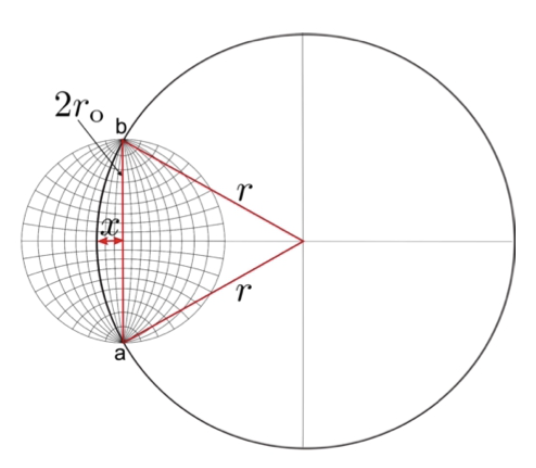
10. State the mathematical formula for the radius of a great circle arc on a Wulff net.
The formula is r = (x2 + ro2) / 2x, where x is the offset from the origin and ro is the net radius.
3. Long questions
Wulff net geometry
This module explores the geometric relationship between the radius of a great circle arc and the dimensions of a Wulff net.
The curve representing a great circle on a Wulff net is an arc of a circle. If the Wulff net has a radius of ro and the offset of the trace from the origin is x, what is the formula for the radius r of this arc?
Figure 2.3: Construction and characteristics of stereographic projection
Click to see the derivation and answer
The derivation
Identify the geometry: In the figure, the vertical distance between points a and b is 2ro.
Apply Pythagoras theorem: The relationship between the radius and the offset is determined as:
r2 - ro2 = (r - x)2
Solve for r: Simplifying the algebraic expression leads to:
r = (x2 + ro2) / 2x
Final answer
The radius r of the arc is defined by the formula:
r = (x2 + ro2) / 2x
Constraint: ro ≤ r ≤ ∞.
4. Essay questions
Develop detailed responses for these prompts. Click "Show Hint" for structural guidance.
Symmetry and physical properties: Contrast centrosymmetric and non-centrosymmetric point groups in the context of piezoelectricity.
Hint: Explain how an inversion centre balances charges and why its absence allows mechanical stress to shift the centre of gravity of ions, creating a dipole.
Crystallographic trace analysis: Discuss how stereographic traces predict plate patterns in meteorites sectioned on different planes.
Hint: Mention the intersection of {111}F planes with the surface and how the stereogram helps visualise resulting shapes like triangles or squares.
Symmetry and physical properties Compare centrosymmetric and non-centrosymmetric point groups regarding piezoelectricity.
Hint: Mention the intersection of {111}F planes with the surface and how the stereo Define the "centre of symmetry." Explain how the absence of this centre allows for the creation of an electrical dipole during deformation (piezoelectricity). Use PbTiO3 or GaN as examples.
5. Glossary
Anisotropy
Variation of physical properties depending on the crystallographic direction.
Habit plane
The plane along which a new phase (e.g., ferrite plates) grows within a parent matrix.
Piezoelectricity
Electrical polarization induced by mechanical stress, requiring a lack of a centre of symmetry.
Wulff net
A stereographic projection of a grid used to measure angles between poles.