![[Queen Mary University of London]](https://www.phase-trans.msm.cam.ac.uk/QMUL.png)

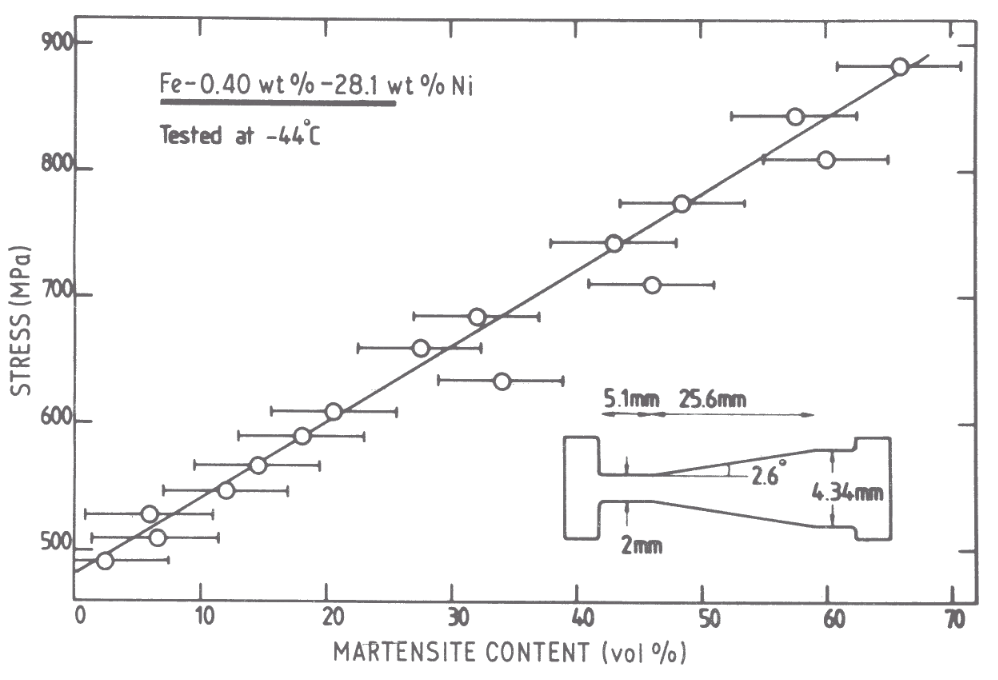
In steels where the martensite transformation occurs in a well-behaved and progressive manner, it has been experimentally established that the number of pre-existing nuclei that develop into new plates of martensite (per unit volume of austenite) on undercooling below the martensite transformation temperature, MS, is directly related to the corresponding increase in transformation driving force. Such a relationship cannot, however, be studied in steels which transform by a burst mechanism, since the role of the initial distribution of nuclei is swamped by the creation of numerous new (autocatalytic) nuclei. In the present work, an experiment designed to overcome this difficulty by suppressing the growth of autocatalytically generated nuclei is conducted, thus enabling the verification of the above relationship for a classic Fe-Ni-C burst-transformation alloy.
This scientific paper investigates the nucleation process of burst martensite within specific steel alloys. While typical martensitic transformations occur progressively, certain materials experience sudden bursts caused by autocatalytic nucleation, which makes studying initial site distributions difficult. The researcher developed an experimental method using applied stress at temperatures above the normal transformation point to isolate and observe these pre-existing nuclei. By utilizing a tapered tensile specimen made of an iron-nickel-carbon alloy, the study successfully measured the relationship between mechanical driving force and the resulting volume fraction of martensite. The findings confirm that the mathematical models used for gradual transformations can also be applied to understanding the mechanics of burst transformations when external constraints are utilised.
Download: Journal of Materials Science, Vol. 17, 1982, pp. 383-386
 Published 2025 |
 Published 2024 preview, video |
 Free download |
 Free download |
 Rails, 2024 |
 Translation, 2020 |
 Published 2021 |
 Published 2026 video |
| PT Group Home | Materials Algorithms |