Queen Mary University of London University of Cambridge

Diffusional Formation of Ferrite in Iron and its Alloys

Scripta Metallurgica, Vol. 21, 1987, pp. 1605-1609 by H. K. D. H. Bhadeshia.

In this technical paper, H.K.D.H. Bhadeshia defends a specific model of ferrite formation in iron alloys against criticisms regarding the transformation mechanism. The author argues that Widmanstätten ferrite grows through a displacive process involving coordinated atomic movements and strain energy minimisation, rather than through simple diffusion-controlled steps.

By addressing points on interface structure and nucleation, the text identifies flaws in competing theories and experimental interpretations, such as those regarding cooling rates and solute drag. Ultimately, the source reinforces the validity of a wedge-shaped growth morphology and the necessity of reconstructive diffusion in all diffusional transformations.

This comprehensive rebuttal aims to clarify the crystallographic and kinetic complexities that govern how crystals transition within solid metals.

Download from journal website.

Audio podcastAudio podcast

theory of transformations in steels

Study Guide: Diffusional Formation of Ferrite in Iron and its Alloys

A comprehensive review of research and theoretical debates regarding shape change, interface structure, and growth kinetics as detailed by H. K. D. B. Bhadeshia.

Review Quiz

Instructions: Answer the following questions based on the provided research context.

  1. What is the primary reason that Widmanstätten ferrite plates grow in mutually accommodating pairs?
  2. How does the "tent-shaped" surface relief observed in Widmanstätten ferrite support the theory of displacive formation?
  3. According to the text, what is the fundamental difference between a "notional" lattice correspondence and a "real" strain?
  4. Why is reconstructive diffusion considered a necessity during all diffusional transformations?
  5. What critique does Bhadeshia offer regarding the use of interface stability models for displacive transformations?
  6. How does the displacive transformation mechanism explain the low interface energy associated with the tip of a Widmanstätten ferrite plate?
  7. What are the primary factors that dominate the mechanism of nucleation according to the provided research?
  8. Why are the thermionic electron emission microscope (THEEM) experiments considered unreliable for assessing the influence of facetting on growth kinetics?
  9. Explain the relationship between Partitioning Local Equilibrium (PLE) and Negligible Partitioning Local Equilibrium (NPLE) in the context of steel growth models.
  10. What is the predicted effect of a gradient energy coefficient on the velocity of a transformation interface?


Answer Key

1. Pair Growth Widmanstätten ferrite plates grow in pairs to minimise the strain energy associated with the invariant-plane strain shape change. This cooperative growth involves two mutually accommodating crystallographic variants that form a macroscopic thin wedge. 2. Surface Relief The tent-shaped relief is characteristic of a pair of mutually accommodating and adjacent invariant-plane strains. This observation confirms that what may appear to be a single plate is actually a cooperative growth of two variants, which is consistent with displacive, paraequilibrium formation. 3. Lattice Correspondence vs. Real Strain A notional lattice correspondence is a conceptual tool used in interface theory regardless of whether crystals are joined. In contrast, a real strain implies a physical atomic correspondence and an associated macroscopic shape change in the transformed region. 4. Necessity of Reconstructive Diffusion Reconstructive diffusion is necessary to prevent the movement of the interface from causing mechanical deformation. Without it, many diffusional reactions would be thermodynamically impossible because the motion of anticoherency dislocations alone is lattice-conserving. 5. Interface Stability Critique Bhadeshia argues that these models, which are based on solute diffusion fields, are inappropriate because the morphology of precipitates in displacive transformations is governed by strain energy minimisation. Furthermore, in cases like bainite, such diffusion fields are entirely absent during growth. 6. Low Interface Energy The displacive mechanism naturally accounts for low interface energy (∼0.2 Jm−2) because of the specific crystallographic relationship with the parent austenite. This is presented as a more robust explanation than postulating an arbitrary density of "closely spaced growth ledges" at the plate tip. 7. Nucleation Factors Nucleation is dominated by the minimisation of strain energy rather than homogeneous deformation. The research indicates that nuclei often form with a crystallography that allows their invariant-lines to lie parallel to the surface plane. 8. THEEM Reliability THEEM experiments are subject to large stereological errors that make the resulting data unusable for assessing facetting. Additionally, these experiments often assume parabolic thickening kinetics, which a facetted interface may not actually obey. 9. PLE and NPLE In the application of Hillert and Kirkaldy-Coates models to steels, PLE and NPLE are mutually exclusive modes of growth. The models show that PLE growth must always occur at a slower rate compared to NPLE growth. 10. Gradient Energy Coefficient A gradient energy coefficient is expected to reduce the interface velocity. This reduction in speed subsequently leads to an increase in the extent of penetration of the diffusion field into the parent phase.

Essay Questions

Glossary of Key Terms

Term Definition
Allotriomorphic Ferrite A form of ferrite where growth is relevant to diffusional transformations and often involves long-range diffusion of alloying elements.
Atomic Correspondence A physical relationship between the atoms of the parent and product crystals, implied by a real transformation strain.
Bainite A transformation product where growth is described as diffusionless, meaning solute diffusion fields are not present during its formation.
Displacive Transformation A phase change occurring through a coordinated movement of atoms, typically resulting in a macroscopic shape change.
Invariant-Plane Strain A specific type of shape change accompanying the formation of a ferrite plate; often accommodated by pairs to minimise energy.
Paraequilibrium A state during which the displacive formation of Widmanstätten ferrite occurs, involving cooperative growth of variants.
Reconstructive Diffusion A necessary process in diffusional transformations that accomplishes the lattice change and prevents mechanical deformation.
Widmanstätten Ferrite Ferrite that forms as plates EXHIBITING tent-shaped surface relief and characterised by a displacive transformation mechanism.
Pearlite in steels
Published 2025
Audio summaries
Steels 5th edition Published 2024
Bainite 3rd edition Free download
Crystallography 1st edition Free download Audio, video summaries
Bainite at play Published 2026 video
Theory of transformations in steels Free download
Functional Materials Free book Hard copy
Phase transitions
Free book,
source (CC-BY)
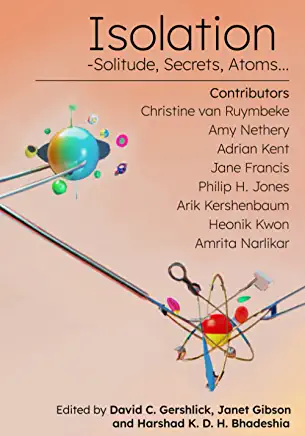
Isolation Free download
rail steels
Rails, 2024
Audio summary
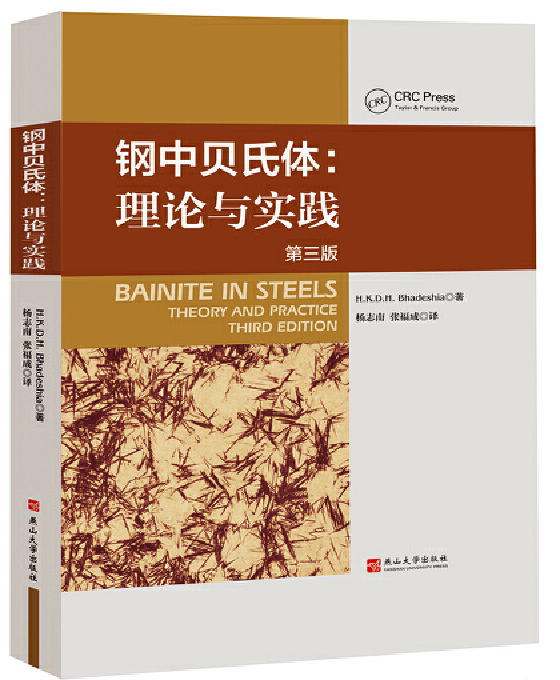
Bainite in Steels, Chinese edition Translation, 2020
Innovations in everyday engineering materials
Published 2021