
Queen Mary University of London University of Cambridge

Nitrogen in Submerged-Arc Weld Deposits

Journal of Materials Science Letters, Vol. 7, 1988, pp. 610-612. H. K. D. H. Bhadeshia, L. -E. Svensson and B. Gretoft

This research examines how nitrogen affects the properties of submerged-arc weld deposits in low-alloy steel. While nitrogen is usually an unintentional impurity, its presence can lead to embrittlement and a significant loss of toughness.

The authors utilise thermodynamic models to explain how the nitrogen concentration in a weld is influenced by the chemical composition of the alloy and the nitrogen levels in the welding wire. Their experimental data confirms that increasing the welding current typically results in a decrease in nitrogen content within the final weld.

Ultimately, the study provides a method for predicting nitrogen levels based on the specific consumables and welding parameters used during the process.

Download from journal website.

Audio podcastAudio podcast

arc weld

Study Guide: Nitrogen in Submerged-Arc Weld Deposits

A review of the research by H. K. D. H. Bhadeshia, L.-E. Svensson, and B. Gretoft regarding the behaviour and impact of nitrogen.

Part 1: Short-Answer Quiz

Instructions: Answer the following questions in 2–3 sentences based on the information provided in the source text.

  1. What are the primary origins of nitrogen found in low-alloy steel weld deposits?
  2. How does nitrogen presence specifically affect the mechanical properties and toughness of a weld?
  3. According to the thermodynamic principles cited, how does nitrogen activity (aN) relate to its partial pressure (PN)?
  4. What does the activity coefficient (f) represent in the context of nitrogen solubility?
  5. What is the role of the Wagner interaction parameter (ei) in this study?
  6. Why were the experimental welds prepared as ISO2560 all-weld metal joints?
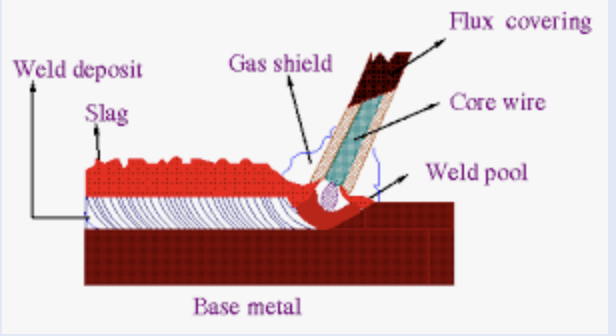
  7. How does the submerged-arc welding process isolate the weld from the environment compared to other methods?
  8. What was the observed relationship between welding current and nitrogen concentration in the weld deposits?
  9. Why is the total nitrogen content measured by Leco furnaces assumed to be equivalent to the dissolved nitrogen?
  10. What is the significance of the nitrogen content in the welding wire (Nw) for the submerged-arc process?

Part 2: Answer Key

1. Primary Origins Nitrogen is typically an unintentional addition picked up from the surrounding environment and impurities within the consumables used during welding. In cases where the weld is diluted by the parent plate, the composition of that plate also influences the final nitrogen concentration. 2. Impact on Properties Nitrogen has a potent detrimental effect on toughness by increasing the yield stress of the weld through strain hardening and solid-solution hardening. These mechanisms lead to the embrittlement of the weld, resulting in an overall decrease in toughness. 3. Activity and Partial Pressure Nitrogen is a diatomic gas, meaning its activity in liquid steel varies with the square root of the partial pressure of nitrogen in the gas equilibrium (aN = K√PN). The proportionality constant (K) used in this relationship is dependent on the temperature of the liquid steel. 4. Activity Coefficient (f) The activity coefficient represents the influence of various alloying additions on the solubility of nitrogen within dilute liquid steel. It is used to relate the nitrogen activity to the actual concentration of nitrogen (xN) through the formula aN = f xN. 5. Wagner Interaction Parameter (ei) The Wagner interaction parameter is used to calculate the activity coefficient by accounting for the interaction between nitrogen and other specific alloying elements. It allows researchers to rationalise how different chemical compositions in the steel affect nitrogen's behaviour at equilibrium. 6. ISO2560 Preparation The ISO2560 preparation was used to ensure that the chemical composition and nitrogen concentration of the results were not influenced by dilution from the base plate. This allows the study to focus exclusively on the properties of the weld metal itself. 7. Submerged-Arc Isolation In submerged-arc welding, the arc and the heated area are isolated from the atmosphere by a fused flux. This automatic process minimises variations that typically arise in manual metal arc welding, providing more consistent experimental conditions. 8. Current and Concentration The research indicates that the welding current significantly influences nitrogen concentration, though the exact mechanism is not fully clear. Generally, an increase in welding current results in a decrease in the nitrogen concentration of the weld. 9. Leco Furnace Measurements The assumption is considered reasonable because there were no deliberate additions of aluminium or titanium, which usually bind nitrogen. Since any trace amounts of these elements were present only as oxides, they did not interfere with the dissolved nitrogen levels. 10. Wire Nitrogen Content (Nw) The study assumes that in the submerged-arc process, the majority of nitrogen in the arc is derived from the wire consumable. Experimental data showed a good linear agreement when plotting wire nitrogen content against the final weld nitrogen concentration.

Part 3: Essay Questions

Instructions: Use the following prompts to develop deeper analytical responses.

Part 4: Glossary of Key Terms

Term Definition
Activity (aN) A measure of the effective concentration of nitrogen in the liquid steel, used in thermodynamic equilibrium equations.
Activity Coefficient (f) A factor that accounts for deviations from ideal behaviour; it represents the influence of alloying elements on nitrogen solubility.
Diatomic Gas A gas consisting of two atoms of the same element; nitrogen (N2) is diatomic, which dictates its relationship with partial pressure (Sievert's Law).
Embrittlement A loss of ductility or toughness in a material, making it brittle; caused by nitrogen-induced hardening.
Interaction Parameter (ei) A value (Wagner interaction parameter) that quantifies how the presence of one alloying element (i) affects the activity of another.
Solid-Solution Hardening A type of alloying where solute atoms (like nitrogen) join the crystalline lattice, increasing yield strength but reducing toughness.
Submerged-Arc Welding (SAW) A welding process where the arc is struck beneath a layer of granular flux, isolating the weld from the environment.
Pearlite in steels
Published 2025
Audio summaries
Steels 5th edition Published 2024
Bainite 3rd edition Free download
Crystallography 1st edition Free download Audio, video summaries
Bainite at play Published 2026 video
Theory of transformations in steels Free download
Functional Materials Free book Hard copy
Phase transitions
Free book,
source (CC-BY)
Isolation Free download
rail steels
Rails, 2024
Audio summary
Bainite in Steels, Chinese edition Translation, 2020
Innovations in everyday engineering materials
Published 2021