
Queen Mary University of London University of Cambridge

The Non-Uniform Distribution of Inclusions in Low-Alloy Steel Weld Deposits

Proceedings of an International Conference: Phase Transformations '87, Institute of Metals, London, Edited by G. W. Lorimer, 1988, pp. 211-215. I. Stark, G. D. W. Smith and H. K. D. H. Bhadeshia

This scientific paper investigates the elemental redistribution that occurs during the formation of bainite in high-silicon steels. Using atom-probe analysis, the researchers examined the "incomplete-reaction phenomenon", where the transformation stops before reaching chemical equilibrium.

The study provides evidence that bainitic ferrite forms with a significant carbon supersaturation, suggesting a growth mechanism that is largely independent of carbon diffusion. While manganese was found to redistribute at the interfaces after long periods of heating, the lack of such movement during the initial transformation refutes theories involving solute-drag effects.

Ultimately, the findings support a displacive mechanism for bainite growth, where the structural change occurs too rapidly for substantial alloying elements to partition between the different phases.

Download publication

Audio podcastAudio podcast

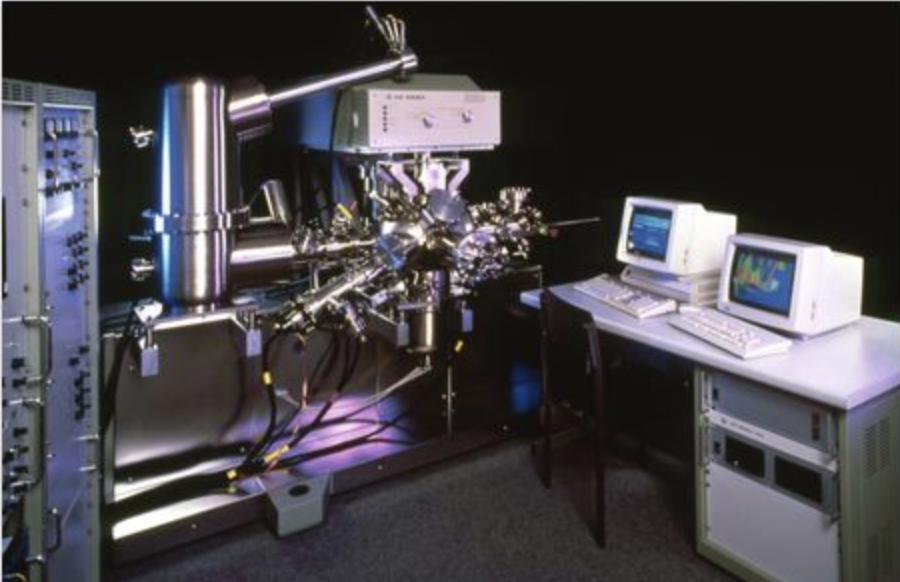
Bob Waugh's atom probe

Element Redistribution and the Incomplete-Reaction Phenomenon in Bainitic Steels

A review of atom-probe analysis in high-silicon alloys regarding carbon, manganese, and silicon behaviour.

Short-Answer Quiz

Instructions: Answer the following questions in 2–3 sentences based on the provided research context.

1. Define the "incomplete-reaction phenomenon" as described in the text. The incomplete-reaction phenomenon refers to the observation that bainite transformation stops even when the austenite has not reached its equilibrium carbon concentration. In these cases, the transformation ends when the carbon level in the austenite is significantly lower than the level predicted by the Ae3' phase boundary. 2. Why is silicon specifically included in the alloys used for this study? Silicon is added to the alloys to prevent the formation of carbides during the bainite transformation process. By inhibiting carbide precipitation, researchers can more accurately measure the carbon concentration of the austenite and ferrite at the end of the transformation without interference from secondary reactions. 3. What is the primary advantage of using atom-probe (AP) analysis in this research compared to other methods? Atom-probe analysis allows for the direct measurement of carbon concentrations and fine-scale variations in carbon levels with high resolution. Unlike X-ray diffraction or dilatometry, which provide indirect or bulk measurements, the atom probe can detect local chemical changes at the atomic level across interfaces. 4. How does the observed carbon concentration in austenite at the end of transformation relate to the T0 and Ae3' lines? The study found that the carbon levels at which austenite stops transforming to bainite are much closer to the T0 curve than to the Ae3' equilibrium line. This suggests that the transformation is limited by thermodynamic factors related to diffusionless growth rather than reaching full chemical equilibrium. 5. What were the findings regarding manganese redistribution at the ferrite/austenite interface? The research indicated that manganese redistribution does not occur during the actual transformation but happens after prolonged ageing at the reaction temperature. Observations showed manganese enrichment at the interface and corresponding depletion in the adjacent ferrite only after several hours of isothermal holding. 6. Does the evidence support the "solute-drag-like effect" as the cause of the incomplete reaction? No, the study found no evidence for a solute-drag-like effect during the transformation itself. Manganese redistribution was only observed well after the initial reaction had finished, suggesting it is a post-transformation ageing effect rather than a kinetic inhibitor of the growth process. 7. What evidence is provided to show that bainitic ferrite forms with carbon supersaturation? Atom-probe measurements revealed carbon levels in the ferrite as high as 0.7 at.% to 10 at.%, which are significantly higher than the calculated equilibrium levels of less than 0.06 at.%. The distribution of this carbon is non-random, often associated with segregation at defects like dislocations or Cottrell atmospheres. 8. What happens to the mass flux of silicon during carbide formation in Fe-C-Si alloys? During the secondary process of carbide formation at 300–340°C, silicon is rejected from the carbides into the surrounding ferrite. The data indicates that the mass flux of silicon from austenite to ferrite is lower than that of manganese, which explains why its redistribution is less obvious during certain stages. 9. How does the bulk carbon level of the alloy affect the amount of carbon retained in the ferrite? The study found that doubling the bulk carbon level to decrease the rate of carbon diffusion in ferrite did not significantly affect the amount of carbon retained. This suggests that the retention of carbon is more closely linked to interface defects and supersaturation during growth than to subsequent diffusion rates. 10. Why do the findings support the diffusionless growth hypothesis for bainite? The results show that austenite carbon levels are consistent with the T0 limit and that bainite forms with high levels of carbon supersaturation. These factors indicate that the transformation involves shear at velocities exceeding carbon diffusion rates, which is a hallmark of diffusionless growth.

Answer Key Summary

Essay Questions

Glossary of Key Terms

Term Definition
Ae3' The para-equilibrium phase boundary between austenite and the (austenite + ferrite) field.
Atom-Probe (AP) A high-resolution analytical technique used to determine the chemical identity and spatial position of individual atoms.
Bainitic Ferrite A product of the bainite transformation, characterised in this study by carbon supersaturation.
Cottrell Atmosphere A concentration of solute atoms (like carbon) around a dislocation, which stabilises the defect.
Diffusionless Growth A transformation mechanism where the product phase grows via a shear-like process without long-range diffusion.
Isothermal Ageing Holding a material at a constant temperature for an extended period to allow for slow chemical changes.
Para-equilibrium A state where only interstitial atoms (carbon) reach equilibrium, while substitutional atoms (manganese, silicon) remain immobile.
T0 Line The temperature-composition limit where the Gibbs free energies of the austenite and ferrite phases are equal.
Pearlite in steels
Published 2025
Audio summaries
Steels 5th edition Published 2024
Bainite 3rd edition Free download
Crystallography 1st edition Free download Audio, video summaries
Bainite at play Published 2026 video
Theory of transformations in steels Free download
Functional Materials Free book Hard copy
Phase transitions
Free book,
source (CC-BY)
Isolation Free download
rail steels
Rails, 2024
Audio summary
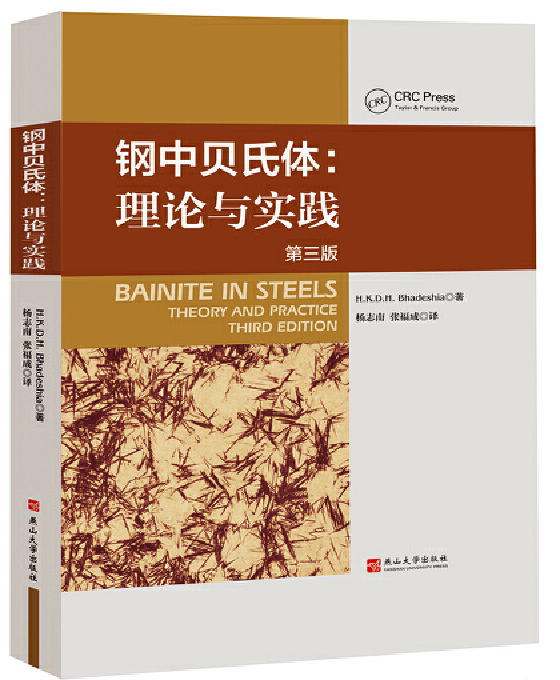
Bainite in Steels, Chinese edition Translation, 2020
Innovations in everyday engineering materials
Published 2021