The resistance of stainless steels to corrosion comes from the formation of an invisible Cr2O3 layer, of typical thickness between 10 and 40 nm, through which atomic transport is so slow that corrosion is kinetically blocked.
For this film to be effective, it must cover the surface and regenerate rapidely when damaged. It is believed that these conditions are met only when the chromium content of a stainless steels exceeds about 11%.
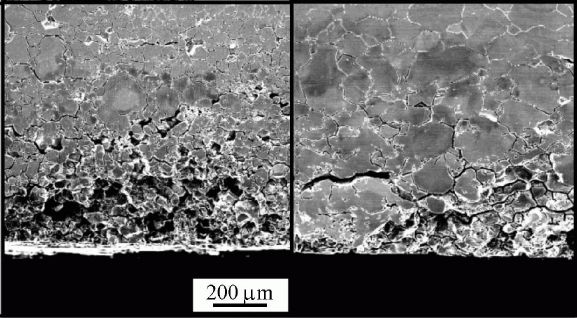
There are various mechanisms which can lead to the corrosion of otherwise stainless steels. One such mechanism causing widespread problems in austenitic stainless steels, particularly in welding, is known as sensitisation. This problem can be so severe as to cause grain decohesion, as shown in the picture below.
|
|
In normal conditions, austenitic stainless steels are given a
high-temperature heat-treatment, often called solution-treatment, which,
as its name indicates, aims at obtaining a single f.c.c. solid solution
(austenite).
At lower temperatures however, this solution is not stable: in the basic AISI
304, the carbon content exceeds the solubility limit in austenite.
This is due to the presence of chromium, which forms stable carbides.
In austenitic steels, the chromium carbides are M23C6 (see Sourmail, 2001 for more details about this phase), in which M stands for Cr, Fe and possibly some Mn and Mo if present in the bulk. Because the formation of these carbides involve long-range diffusion, it can be avoided by quenching the steel after the solution-treatment.
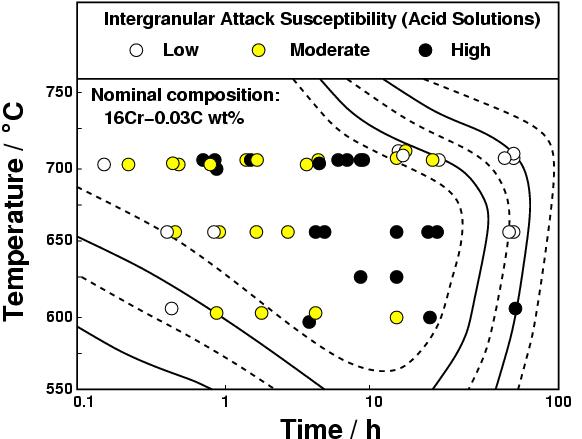
If the steel is subsequently re-heated, precipitation of M23C6 may occur. Because nucleation is considerably easier on grain boundaries, there is a very strong tendency for localised precipitation. Precipitation on other defects (twin boundaries, dislocations, inclusions..) do occur, although after longer exposure at high temperatures. Although this depends on the composition, M23C6 may be found on grain boundaries after only a few minutes at temperatures around 750 C. The range of temperature in which sensitisation occurs is bounded in the lower temperatures by the very slow kinetics of diffusion controlled transformations, and in the higher temperatures, by the fact that chromium depletion is less pronounced at higher temperatures. As illustrated below, the conditions in which a steel is sensitised vary with temperature and time.
|
When austenitic stainless steels are welded, any metal which has been melted usually cools fast enough to prevent carbides formation. However, in the metal adjacent to the fusion zone, the so-called heat-affected zone (HAZ), the temperature changes might be such that sensitisation occurs.
Various solutions can be implemented to avoid sensitisation:
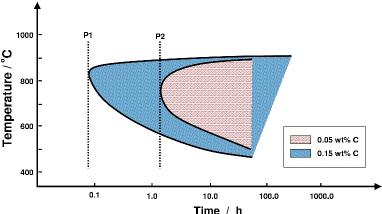
the first one is obviously to reduce the carbon content of the material so as to limit the precipitation of M23C6. This approach defines the AISI L grades, such as 304L and 316L which have lower carbon content than their standard counterparts. For both these steels, the maximum acceptable carbon content is reduced to 0.03 wt% (from 0.08 for the corresponding standard grades).
|
another `similar' solution consists in introducing carbides former which
have an even greater affinity for carbon than chromium. These include Nb, Ti, V
or Ta. Steels containing additions of either of these elements (or a
combination) are said to be stabilised (with regard to grain boundary
precipitation of M23C6).
Grades 321 (Ti stabilised) and 347 (Nb stabilised) represent the most common
stabilised austenitic stainless steels. In welding applications, grade 321 is
not used as a filler metal because titanium does not transfer well accross a
high temperature arc. 347 is therefore used as a filler metal when joining
components made out of 321 or 347 (the latter being seldom used as parent
material).
To obtain stabilisation, it is not sufficient to add Nb or Ti. A stabilisation
heat-treatment must be performed to ensure formation of TiC or NbC. This is
usually performed by holding the steel for 1 or more hours at temperatures
around 900 C. At lower temperatures, M23C6 may form faster than TiC or NbC.
in some cases, a solution-treatment can be given to dissolve carbides which may have formed on grain boundaries, after welding for example.
a variety of other factors intervene in the problem, such as grain size and the nature of the grain boundary. It has been shown that sensitisation could be avoided by grain boundary engineering (Shimada, 2002), in which a thermomechanical treatment produces a microstructure with mostly low angle grain boundaries. These have a lower energy and are therefore less potent nucleation sites for M23C6. On the other hand, it appears that increasing the orientation randomness of the grain boundaries beyond a treshold can also lead to a reduction in sensitisation (Wasnik, 2002), in this study however, it is possible that the cause is a grain size reduction rather than a change in the nature of the grain boundaries.
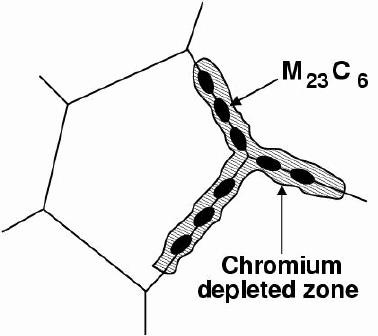
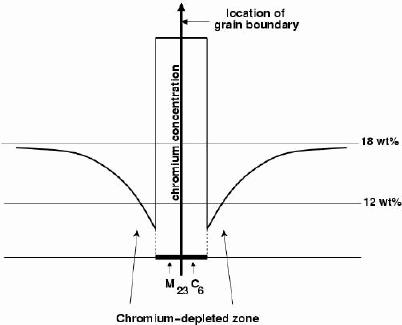
As explained earlier, sensitisation is caused by the formation of chromium carbides on grain boundaries. The Cr-rich precipitate draw chromium from the adjacent matrix, which results in the formation of a chromium depleted zone. If the chromium content is below 11-12% in this area, the steel is said to be sensitised.
|
|
This short description of the problem hides most of its interesting
complexity. The first difficulty occurs if one considers the phase diagram
austenite/M23C6. This predicts that the chromium content of the austenite in
equilibrium with M23C6 is only slightly lower than the bulk composition, which
makes sense if one remembers that M23C6 seldom form than 1% volume fraction.
The reason why the chromium content locally drops to much lower values is to be
found in the dynamics of the fluxes of elements diffusing towards the
precipitates. This problem is reviewed in details in Too, 2002 and Sourmail et
al, 2003
 |
|
|
| PT Group Home | Materials Algorithms |

|

|