

Queen Mary University of London University of Cambridge

Computer aided design of electrodes for arc welding processes, part II

Proceedings of the Second International Conference on Computer Technology in Welding, The Welding Institute, Cambridge, 1988, paper 24. By L.-E. Svensson, B. Gretoft, A. A. B. Sugden and H. K. D. H. Bhadeshia

This academic paper details the ongoing creation of computer software designed to predict the metallurgical properties of steel arc welds. By utilising phase transformation theory, the researchers have developed a model that calculates the microstructure and yield strength of multirun weld deposits based on their chemical makeup and welding environment.

The study specifically categorises weld regions into primary and secondary microstructures to account for the complex effects of reheating during the welding process. Additionally, the authors propose a method for estimating nitrogen concentrations, which significantly impact the overall toughness of the metal.

Ultimately, the researchers demonstrate that their mathematical calculations align closely with experimental data, offering a more reliable alternative to traditional empirical equations.

Download publication

Audio podcastAudio podcast

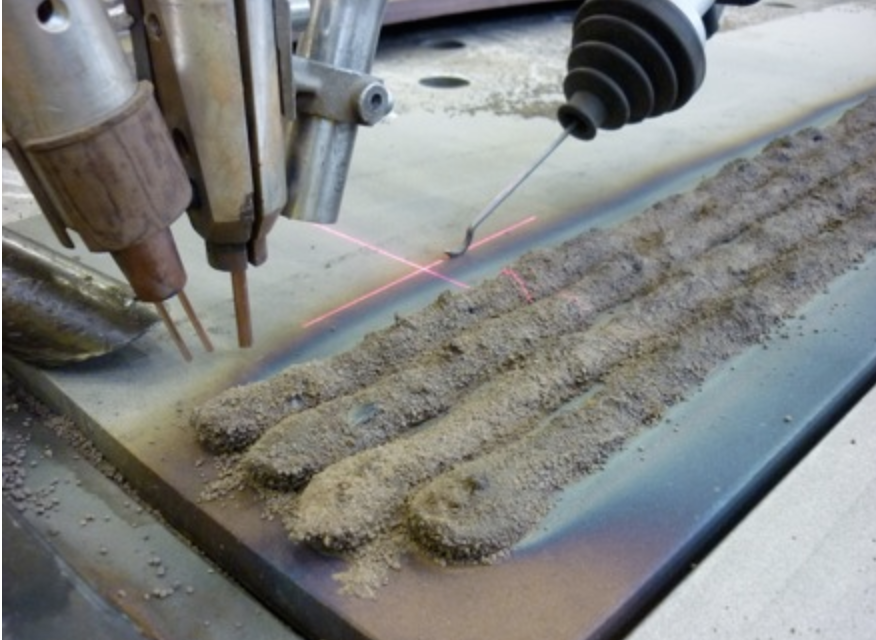
submerged arc weld

Study Guide: Computer-Aided Design of Electrodes for Arc Welding Processes

A comprehensive review of the physical metallurgy of steel welds and the prediction of microstructure and yield strength in multirun manual metal arc weld deposits.

Short-Answer Quiz

Instructions: Answer the following questions in 2-3 sentences based on the provided text.

  1. What is the primary objective of the computer software described in the report?
  2. How does the "primary microstructure" of a weld differ from the "secondary microstructure"?
  3. What specific chemical elements are considered when calculating phase transformations in the software?
  4. According to the strength model, what three factors are summed to determine the overall strength of a multiphase system?
  5. Why is the concentration of nitrogen monitored in weld deposits?
  6. What is the role of the Ae3' temperature in the study of multirun welds?
  7. How is the microstructural contribution to strength (σMICRO) specifically calculated for the primary microstructure?
  8. What happens to the microstructural strengthening components in the reheated (secondary) regions of a weld?
  9. What is the relationship between nitrogen activity in liquid steel and the partial pressure of nitrogen?
  10. Why is the common practice of using empirical equations for weld metal strength considered unsatisfactory by the authors?

Quiz Answer Key

1. Primary Objective The software is designed to enable the theoretical design of welding consumables and procedures by predicting the microstructure and macroscopic yield strength of arc welds. It utilises physical metallurgy and phase transformation theory to account for alloy chemistry and welding conditions. 2. Primary vs. Secondary Microstructure The primary microstructure is obtained as the weld cools from the liquid phase to ambient temperature, consisting of phases like allotriomorphic and acicular ferrite. The secondary microstructure refers to regions of the original primary microstructure that have been reheated and altered by the thermal cycles of subsequent weld beads. 3. Chemical Elements Considered The software accounts for the chemical composition of several alloying elements, specifically carbon (c), silicon (si), manganese (mn), nickel (ni), chromium (cr), molybdenum (mo), and vanadium (v). It also considers the influence of these elements on solidification sequence and element segregation. 4. Determination of Overall Strength The model assumes that strength is factorised into the intrinsic strength of pure annealed iron (σFe), the contribution from solid solution strengthening (σss), and the contribution from the microstructural phases (σMICRO). These components are added together to represent the total yield strength. 5. Nitrogen Monitoring Nitrogen is monitored because it has a potent detrimental effect on the toughness of the weld, potentially causing embrittlement through strain hardening and solid solution hardening. These effects increase the yield stress but subsequently lead to a decrease in overall toughness. 6. Role of Ae3' Temperature The Ae3' paraequilibrium temperature is used as an approximation to estimate the volume fractions of the primary and secondary regions in a multirun weld. Research indicates that microstructural proportions are largely explained by the thermodynamic effects of alloying elements on transformations from austenite. 7. Calculation of σMICRO σMICRO is calculated by multiplying the volume fractions of the three major phases—allotriomorphic ferrite (Vα), Widmanstätten ferrite (Va), and acicular ferrite (Vw)—by their respective strength coefficients (27, 402, and 486 MPa). 8. Strengthening in Secondary Regions In the secondary regions, most of the microstructural component of strengthening is lost due to the effects of reheating and tempering. Consequently, the strength of these regions is primarily attributed to solid solution strengthening and the intrinsic strength of the pure annealed iron. 9. Nitrogen Activity and Partial Pressure Based on Sievert's law, nitrogen is a diatomic gas whose activity (aN) in liquid steel varies with the square root of the partial pressure of nitrogen (pN). This is expressed as aN = K √pN, where K is a temperature-dependent proportionality constant. 10. Critique of Empirical Equations Empirical approaches are limited because they often fail to account for the microstructural changes caused by reheating in multirun welds, which occur without changing the chemical composition. The authors argue that a more quantitative basis is needed to accurately relate microstructure to properties.

Essay Questions

Glossary of Key Terms

Term Definition
Acicular Ferrite (αa) A desirable microstructural phase in the primary weld deposit that contributes significantly to strength and toughness.
Ae3' Temperature The paraequilibrium temperature used to estimate the transition of steel to an austenitic state.
Allotriomorphic Ferrite (α) A component of the primary microstructure formed at grain boundaries during the cooling process.
Paraequilibrium A state used in thermodynamic calculations where interstitial elements like carbon reach equilibrium, but substitutional alloying elements do not.
Secondary Microstructure Weld regions modified by the heat of subsequent weld passes, often resulting in reaustenitised or tempered grains.
Solid Solution Strengthening (σss) A method of hardening metals by adding alloying elements that remain in solid solution.
Wagner Interaction Parameter (ei) A value used to calculate the activity coefficient of an element by accounting for the influence of other alloying additions.
Pearlite in steels
Published 2025
Audio summaries
Steels 5th edition Published 2024
Bainite 3rd edition Free download
Crystallography 1st edition Free download Audio, video summaries
Bainite at play Published 2026 video
Theory of transformations in steels Free download
Functional Materials Free book Hard copy
Phase transitions
Free book,
source (CC-BY)
Isolation Free download
rail steels
Rails, 2024
Audio summary
Bainite in Steels, Chinese edition Translation, 2020
Innovations in everyday engineering materials
Published 2021