
Queen Mary University of London University of Cambridge

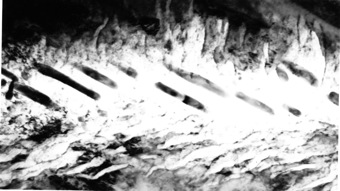
Bainite in steels

Proceedings of an International Conference: Phase Transformations '87, Institute of Metals, London, Edited by G. W. Lorimer, 1988, pp. 309-314, by H.K.D.H. Bhadeshia

This academic paper examines the complex characteristics and formation mechanisms of bainite within steel. The author argues that bainite grows through a displacive, diffusionless process, resulting in a distinct plate-like shape and specific surface relief effects.

Key sections of the text address the "incomplete reaction" phenomenon and the subsequent redistribution of carbon into the surrounding austenite or through carbide precipitation.

Additionally, the research compares bainite to other microstructures like acicular ferrite, highlighting how nucleation sites and transformation temperatures dictate final properties. By reconciling experimental data with theoretical models, the source provides a comprehensive classification of phase transformations in ferrous alloys. These findings ultimately aim to improve the predictive modelling of steel microstructures during industrial heat treatment.

---

Download publication

Audio podcastAudio podcast

Study Guide: Bainite in Steels

A comprehensive review of the characteristics, mechanisms, and phenomena associated with bainitic transformations in steels, based on the research by H. K. D. H. Bhadeshia.

Short-Answer Quiz

Instructions: Answer the following questions using 2–3 sentences based on the provided text.

  1. Describe the "sheaf" morphology of bainite.
  2. What is the significance of the Invariant-Plane Strain (IPS) shape change in bainite formation?
  3. What primary factor distinguishes upper bainite from lower bainite regarding carbide precipitation?
  4. Explain the "incomplete reaction phenomenon."
  5. What is the T0 curve and how does it limit bainite growth?
  6. How does the nucleation of acicular ferrite differ from that of conventional bainite?
  7. What role do inclusions play in the development of acicular ferrite?
  8. How does the dislocation density in lower bainite affect carbide precipitation?
  9. According to the source, how does the composition of cementite change during the tempering of bainite?
  10. What is the fundamental difference between the growth of Widmanstätten ferrite and bainite?

Quiz Answer Key

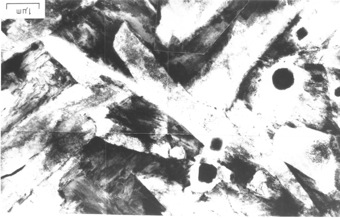
1. Describe the "sheaf" morphology of bainite. Bainite grows as aggregates called "sheaves," which consist of many small, lenticular platelets (sub-units) of ferrite. These sub-units are separated by regions of residual austenite, martensite, or cementite, and the entire sheaf possesses a wedge-shaped macroscopic form. 2. What is the significance of the Invariant-Plane Strain (IPS) shape change in bainite formation? The IPS shape change indicates a coordinated movement of atoms during transformation, implying an atomic correspondence between the parent and product phases. This deformation results in a stored energy of approximately 400 J/mol, which influences the plate shape to minimise strain energy. 3. What primary factor distinguishes upper bainite from lower bainite regarding carbide precipitation? In upper bainite, carbides precipitate exclusively from the carbon-enriched residual austenite between the ferrite plates. In lower bainite, carbides additionally precipitate within the bainitic ferrite plates themselves due to the higher carbon supersaturation and dislocation density. 4. Explain the "incomplete reaction phenomenon." This phenomenon occurs when the transformation of austenite to bainite stops prematurely before reaching the equilibrium carbon concentration. The reaction ceases when the carbon concentration of the residual austenite reaches the T0 boundary, where the free energies of austenite and ferrite of the same composition are equal. 5. What is the T0 curve and how does it limit bainite growth? The T0 curve represents the locus of points on a phase diagram where austenite and ferrite of identical composition have equal free energy. Because bainite growth is diffusionless, it can only occur if the carbon concentration of the austenite is to the left of the T0 curve, providing the necessary driving force for transformation. 6. How does the nucleation of acicular ferrite differ from that of conventional bainite? Conventional bainite typically nucleates at austenite grain surfaces and grows as sheaves of parallel plates. In contrast, acicular ferrite nucleates intragranularly on non-metallic inclusions, resulting in a more chaotic, randomly oriented morphology of plates. 7. What role do inclusions play in the development of acicular ferrite? Inclusions serve as heterogeneous nucleation sites within large austenite grains, allowing plates to nucleate and grow in many different directions. This intragranular nucleation prevents the formation of organised sheaves and leads to a microstructure that provides considerable toughness. 8. How does the dislocation density in lower bainite affect carbide precipitation? Lower bainite is characterised by a high dislocation density, which can influence the formation of ε or θ carbides. These carbides precipitate within the ferrite plates to relieve the carbon supersaturation at a rate that competes with the partitioning of carbon into the residual austenite. 9. According to the source, how does the composition of cementite change during the tempering of bainite? During tempering, the concentration of substitutional alloying elements like Chromium (Cr) and Manganese (Mn) in the cementite increases over time. This enrichment follows a t1/3 relationship, where t is the tempering time, as the carbides move toward their equilibrium chemical composition. 10. What is the fundamental difference between the growth of Widmanstätten ferrite and bainite? Widmanstätten ferrite is a reconstructive transformation that grows at a rate controlled by the diffusion of carbon in the austenite ahead of the interface. Bainite, however, grows via a displactive, diffusionless mechanism, with carbon partitioning into the austenite occurring only after the ferrite plate has formed.

Essay Questions

Instructions: Use the provided text to develop detailed responses for the following prompts.


Glossary of Key Terms

Acicular Ferrite (αa)
A phase formed by the intragranular nucleation of plates on inclusions, resulting in a tough, randomly oriented microstructure.
Atomic Correspondence
A condition where the relative positions of atoms are maintained during a phase transformation, characteristic of displactive mechanisms.
Bainitic Ferrite (αb)
The ferritic component of bainite, which grows as small lenticular plates and initially contains a non-equilibrium concentration of carbon.
Incomplete Reaction Phenomenon
A condition where the bainite transformation ceases before the austenite reaches its equilibrium carbon composition, specifically at the T0 limit.
Invariant-Plane Strain (IPS)
A type of deformation associated with displactive transformations that involves a significant shear component and a strain invariant to the habit plane.
Lower Bainite (αlb)
A form of bainite characterised by the precipitation of carbides both within the ferrite plates and between them.
Reconstructive Transformation
A transformation mechanism involving the uncoordinated movement of atoms and the redistribution of all elements, including substitutional alloys.
Sheaf
A macroscopic aggregate of bainitic ferrite sub-units (platelets) that share a common orientation and grow together in a wedge-like shape.
T0 Curve
The boundary on a phase diagram where the Gibbs free energies of the austenite and ferrite phases are equal for a given composition.
Upper Bainite (αub)
A form of bainite where carbides precipitate only from the residual austenite between the ferritic plates, not within the plates themselves.
Pearlite in steels
Published 2025
Audio summaries
Steels 5th edition Published 2024
Bainite 3rd edition Free download
Crystallography 1st edition Free download Audio, video summaries
Bainite at play Published 2026 video
Theory of transformations in steels Free download
Functional Materials Free book Hard copy
Phase transitions
Free book,
source (CC-BY)
Isolation Free download
rail steels
Rails, 2024
Audio summary
Bainite in Steels, Chinese edition Translation, 2020
Innovations in everyday engineering materials
Published 2021