
Abstract
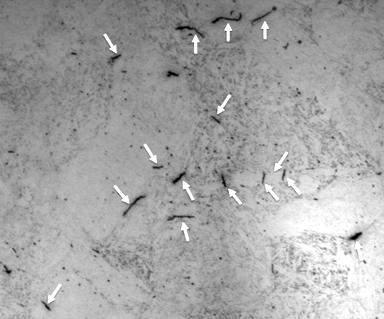
It is demonstrated that a macroscopically homogeneous distribution of tiny cracks introduced into a martensitic bearing steel sample can provide powerful hydrogen traps. The phenomenon has been investigated through thermal desorption spectroscopy and hydrogen permeation measurements using both cracked and integral samples. The effective hydrogen diffusion coefficient through the cracked sample is found to be far less than in the uncracked one. Similarly, when samples are charged with hydrogen, and then subjected to thermal desorption analysis, the amount of hydrogen liberated from the cracked sample is smaller due to the trapping by the cracks. Theoretical analysis of the data shows that the traps due to cracks are so strong, that any hydrogen within the cracks can never in practice de-trap and cause harm by mechanisms that require the hydrogen to be mobile for the onset of embrittlement.
How do microscopic cracks intentionally introduced into martensitic bearing steel mitigate the harmful effects of hydrogen embrittlement? By using thermal desorption spectroscopy and permeation measurements, it is demonstrated that these cracks function as permanent traps that immobilise atomic hydrogen by converting it into a harmless molecular form.
The following thermodynamic and experimental principles emerge:
- Cracked steel exhibits a significantly lower diffusion coefficient, as the cracks prevent hydrogen from migrating toward high-stress areas where it typically causes failure.
- Retained austenite forms a secondary reservoir that influences hydrogen mobility during heating.


Metallurgical and Materials Transactions A 46 (2015) 665-673.
Related papers
- Theories of hydrogen embrittlement
- Percolation of hydrogen
- Hydrogen in Al-rich TWIP steel
- M4C3 precipitation in Fe-C-Mo-V steels and relationship to hydrogen trapping
- Hydrogen in TRIP steel
- Hydrogen in TWIP steel
- Surface hydrogen
- Theory for hydrogen
- Aluminium and hydrogen in TWIP steel
- Thesis on hydrogen desorption