S. W. Seo, G. S. Jung, J. S. Lee, C. M. Bae, H. K. D. H. Bhadeshia and D. W. Suh
Abstract
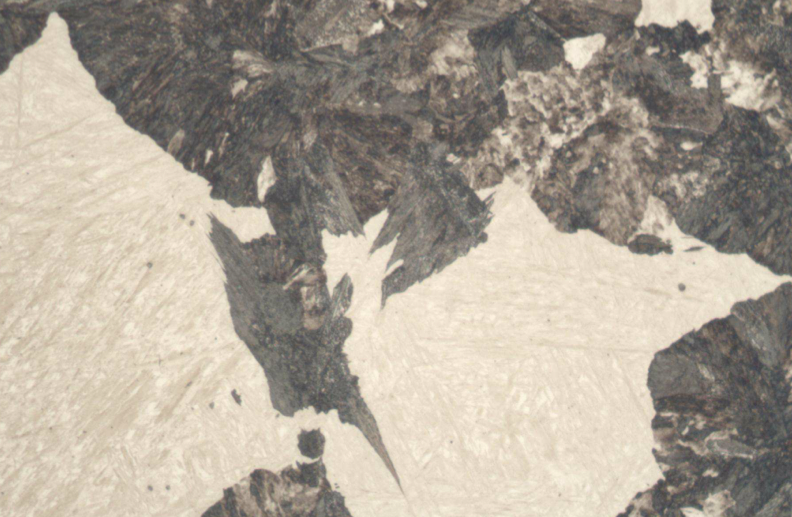
The kinetic theory for the growth of pearlite in binary and ternary steels is implemented to ensure local equilibrium at the transformation front with austenite, while accounting for both boundary and volume diffusion of solutes. Good agreement is on the whole observed with published experimental data, although the reported growth rate at the lowest of temperatures is much smaller than predicted. To investigate this, experiments were conducted to replicate the published data. It is found that the cooperation between cementite and ferrite breaks down at these temperatures, and surface relief experiments are reported to verify that the resulting transformation product is not bainite.
We outline work concerning the speed of pearlite formation in specific steels containing carbon and manganese. Kinetic theory is applied to discover how chemical elements move during phase transformations. While the theory generally align with existing data, new experiments demonstrate again that the growth slows down unexpectedly at lower temperatures. The coordination between ferrite and cementite fails under these conditions, creating a product better described as spiky pearlite where cooperation between α and θ fails.
Materials Science and Technology 31 (2015) 487-493.