 Study guide

A combination of neural networks and genetic algorithms has been used to design a TRIP-assisted steel in which the silicon concentration is kept low. In this context the steel has a novel microstructure consisting of δ-ferrite dendrites and a residual phase which at high temperatures is austenite. This austenite can, with appropriate heat-treatment, evolve into a mixture of bainitic ferrite and carbon-enriched retained austenite. The steel has been manufactured and tested to reveal a tensile strength of about 1 GPa and a uniform elongation of 23%.
Materials Science and Technology 23 (2007) 819-827.
A two-minute interview conducted by Mathew Peet, about the research documented in the paper.
| Audio format | Audio format |
|---|---|
| MP3 | WAV |
| MAP_STEEL_TRIP_AUSTENITE | PROGRAM: To predict the retained austenite content and austenite carbon concentration in TRIP-assisted steels. |
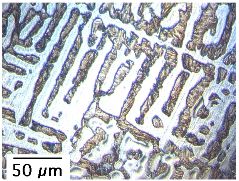 δ-TRIP steel, Fe 0.41C 2.42Mn 0.46Si 1.57Al 0.26P 0.42Cu wt%, as cast. |
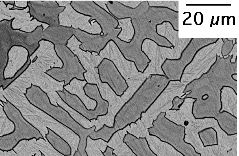 δ-TRIP steel, Fe 0.41C 2.42Mn 0.46Si 1.57Al 0.26P 0.42Cu wt%, as cast. |
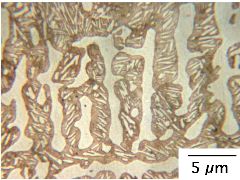 δ-TRIP steel, Fe 0.41C 2.42Mn 0.46Si 1.57Al 0.26P 0.42Cu wt%, heat treated. |
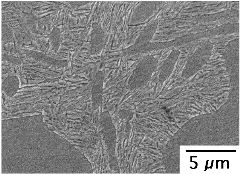 δ-TRIP steel, Fe 0.41C 2.42Mn 0.46Si 1.57Al 0.26P 0.42Cu wt%, heat treated. |
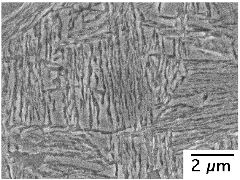 δ-TRIP steel, Fe 0.41C 2.42Mn 0.46Si 1.57Al 0.26P 0.42Cu wt%, heat treated. |
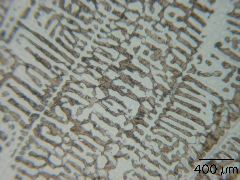 δ-TRIP steel, Fe 0.41C 2.42Mn 0.46Si 1.57Al 0.26P 0.42Cu wt%, as cast. |
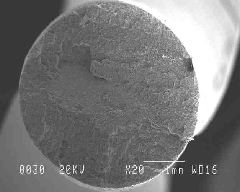 Fractograph of δ-TRIP steel, as cast, tensile tested at ambient temperature. |
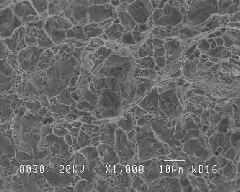 Fractograph of δ-TRIP steel, as cast, tensile tested at ambient temperature. |
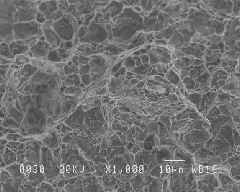 Fractograph of δ-TRIP steel, as cast, tensile tested at ambient temperature. |
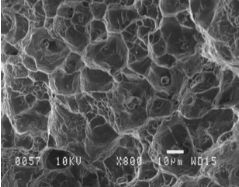 Fractograph of δ-TRIP, as-cast sample, tested at 125 °C. |
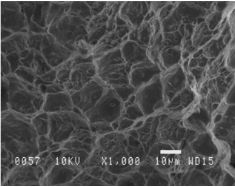 Fractograph of δ-TRIP, as-cast sample, tested at 125 °C. |