

This academic source is a Master of Science thesis by Seung-Woo Seo from the Pohang University of Science and Technology, focusing on the thermodynamic and magnetic properties of κ-carbides in high-strength steels. The research utilises first-principles calculations and density functional theory to investigate the formation enthalpy and electronic structures of these carbides, which are essential for developing lightweight, ductile alloys.
A central component of the study is the development of a Monte-Carlo cell gas model to simulate how temperature affects free energy and entropy without relying on existing databases. The text highlights that while κ-carbides can improve steel performance through shear-band induced plasticity, their size and distribution must be strictly controlled to prevent brittle fracturing and crack propagation.
Ultimately, the work aims to provide precise thermodynamic data for the Fe-Mn-Al-C quaternary system to optimise the design of industrial materials.
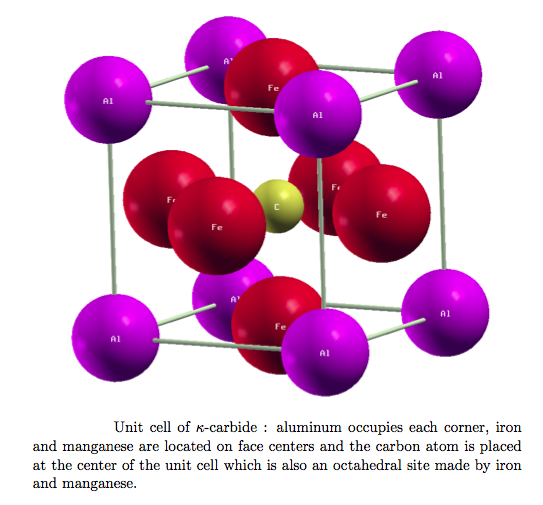
κ carbide has the approximate formula (Fe,Mn)3AlC. The aluminium atoms are located on the corners of the cubic unit cell, iron and manganese atoms at the face centres, with carbon in the octahedral interstices. The unit cell is primitive cubic, with space group Pm3m.
The following images are from the thesis by Seung-Woo Seo.
Thermodynamic and Magnetic Properties in High-Manganese and High-Aluminium Steels
This study guide provides a comprehensive review of research regarding the thermodynamic and magnetic properties of κ-carbide within high-manganese and high-aluminium steels. The material explores the application of Density Functional Theory (DFT) and Monte-Carlo simulations to understand the stability and behaviour of these complex quaternary systems.
Instructions: Answer the following questions in 2–3 sentences based on the provided source context.
1. The research aims to reduce the density of steel for automotive and maritime applications to save energy and protect the environment. By alloying iron with manganese, aluminium, and carbon, researchers seek to maintain high toughness and safety while achieving at least a 10% reduction in weight.
2. κ-carbide has an "anti-perovskite" structure where aluminium atoms occupy the corners of the cubic unit cell and transition metals (Fe, Mn) occupy the face centres. Unlike standard perovskites where a transition metal is at the centre, κ-carbide places a non-metallic carbon atom at the unit cell centre.
3. Aluminium is the key element for lowering steel density because it is a light element, but its concentration is limited in TRIP and TWIP steels. Excessive aluminium increases stacking fault energy, which can suppress the transformation-induced and twinning-induced plasticity effects.
4. κ-carbide improves ductility when it is nano-sized, regularly distributed, and coherent with the austenite matrix, supporting a shear-band induced plasticity (SIP) effect. In contrast, coarsened κ-carbide at phase boundaries tends to initiate and propagate brittle cracks.
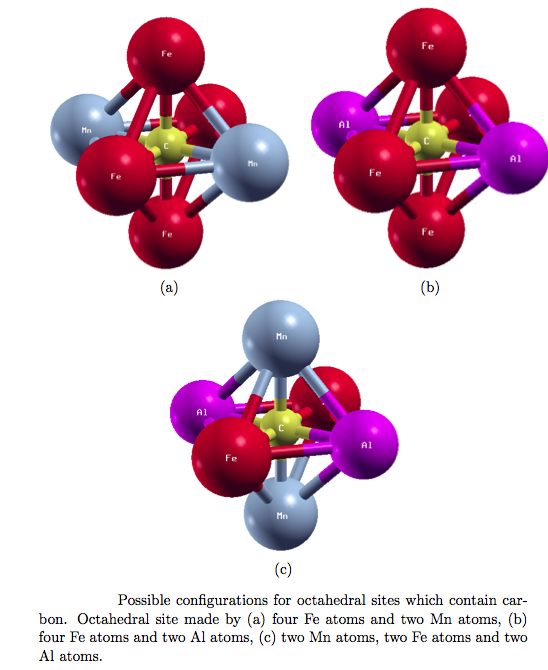
5. The research identified Fe2MnAlC (octa-1) as the most stable structure, possessing the lowest formation enthalpy of −24.8 kJ atom-mol−1. This value is significantly lower than that of Fe3AlC (−16.7 kJ atom-mol−1) and Mn3AlC (−20.0 kJ atom-mol−1).
6. When the carbon position is shifted to alternative octahedral sites, the formation enthalpy becomes positive, indicating these configurations are unstable at 0 K. Specifically, Fe2MnAlC (octa-2) and (octa-3) yielded formation enthalpies of 7.74 and 6.20 kJ atom-mol−1, respectively.
7. In the octa-2 configuration, the manganese atom exhibited a magnetic moment of 3.23 μB. This is more than twice the magnetic moment of manganese found in the Mn3AlC structure (1.29 μB).
8. The three modes are Transformation-Induced Plasticity (TRIP), which involves austenite-to-martensite transformation; Twin-Induced Plasticity (TWIP), utilising mechanical twinning; and Shear-band Induced Plasticity (SIP), supported by fine κ-carbides.
9. The research used the all-electron full-potential linearized augmented plane-wave (FLAPW) method within the generalised gradient approximation (GGA). This method is favoured for its accuracy in calculating the electronic structure and ground-state energy of many-electron systems without empirical fitting parameters.
10. The Monte-Carlo simulation produced an entropy value of 4.85 J K−1 mol−1 per cell, which was roughly three times smaller than the expected configurational entropy of 14.90 J K−1 mol−1. This was attributed to implementation limitations, such as restricted system size and software constraints.
Instructions: Use the provided source context to develop comprehensive responses to the following prompts.
Analyse the classification of alloying elements as either austenite or ferrite stabilisers. Discuss how manganese, carbon, and aluminium specifically influence the phase fields of iron and the resulting stability of κ-carbide.
Explain the "weakest link model" regarding brittle particles in a ductile matrix. Contrast the fracture mechanisms observed when κ-carbide is located within austenite versus when it is located within ferrite.
Detail the theoretical foundations of Density Functional Theory (DFT), including the Hohenberg-Kohn theorems and the Kohn-Sham equation. Explain how these principles allow for the calculation of formation enthalpy and magnetism at 0 K.
| Term | Definition |
|---|---|
| Anti-perovskite | A crystal structure (E21) where the positions of metallic and non-metallic atoms are reversed relative to the standard perovskite structure. |
| CALPHAD | Computer Coupling of Phase Diagrams and Thermochemistry; a method for calculating phase diagrams based on thermodynamic databases. |
| DFT | Density Functional Theory; a quantum mechanical modelling method used to investigate the electronic structure of many-body systems. |
| FLAPW | Full-Potential Linearized Augmented Plane-Wave method; a highly accurate all-electron technique for solving the Kohn-Sham equations in solids. |
| Formation Enthalpy | The change in enthalpy during the formation of one mole of a compound from its constituent elements in their standard states. |
| κ-carbide | A carbide with the formula (Fe,Mn)3AlC, significant for strengthening lightweight steels through the SIP effect. |
| SIP Effect | Shear-band Induced Plasticity; a deformation mechanism where nano-sized κ-carbides support uniform shear bands, enhancing ductility. |