A discussion of diffusion and its microstructural consequences can be found in a set of lectures available online.


We examine the chemical and structural changes that occur when steel is subjected to high-temperature heat treatments in oxygen-rich environments. This process, known as decarburisation, involves the depletion of carbon from the metal’s surface, resulting in a distinct gradient of microstructures ranging from pure ferrite to pearlite.
Steel is incredibly versatile because it can be heat-treated in order to produce a vast range of microstructures and associated mechanical properties. The heat treatment usually involves the steel being heated into a temperature within the austenite phase field. This temperature is quite high, typically in the range 800–1200 °C, depending on the details of the chemical composition.
Commercial heat treatments are generally carried out in electrical resistance furnaces or natural gas fired furnaces. The size of the furnace may range from a moderately sized building designed to handle many thousands of tonnes of steel down to a unit the size of a standard microwave oven.
It is inevitable that the furnace atmosphere contains oxygen. More accurately, the chemical potential of carbon in the atmosphere may be lower than that in the steel being heat-treated. Carbon will therefore be removed from the surface layers of the steel by the process commonly known as decarburisation.
The chemical composition of steel M0 is approximately Fe–0.8C wt%. It has been heated in an electric furnace, without any particular atmospheric protection, at 1200 °C for 2 hours and then cooled slowly to ambient temperature.
The sample of M0 was subsequently ground flat on one surface using SiC grinding paper lubricated with water, followed by polishing with fine diamond paste. Once an acceptable polish was obtained, the sample was etched in 2% nital (a mixture of nitric acid and methanol) for 20 seconds before washing with methanol and drying using warm air. The resulting cross-section reveals the extent of decarburisation at the surface, with remarkable changes in microstructure with distance away from the exposed boundary surface.
You will find below a series of micrographs taken as a function of position away from the surface, plotted across a variety of magnifications. Click on each image preview to access an expanded version. Additional technical data on decarburisation kinetics can be found in the index section at the bottom of the page.
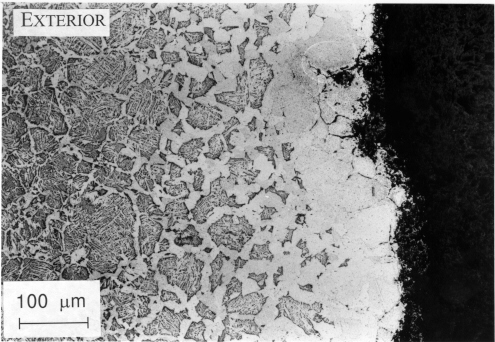
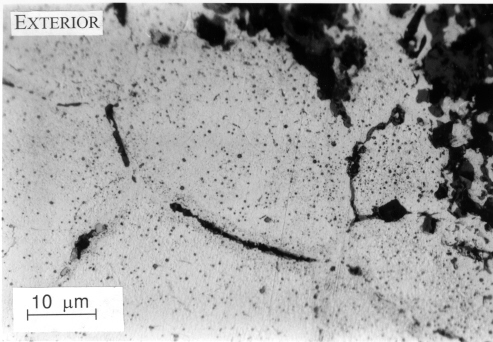
The microstructure directly at the free surface of the steel. Note that the volume fraction of ferrite (the light-etching phase) increases dramatically as the free surface is approached. The ferrite nucleates preferentially at the parent austenite grain boundaries and hence appears as distinct layers. The dark-etching regions are continuous mixtures of Widmanstätten ferrite and pearlite which form after the primary grain boundary layers of ferrite.
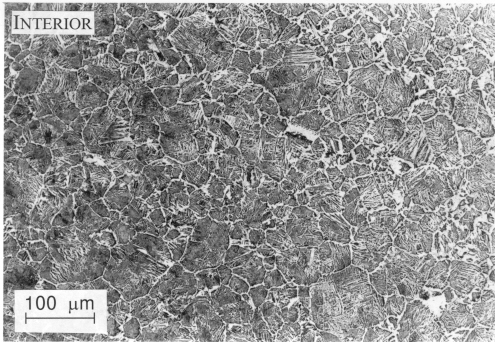
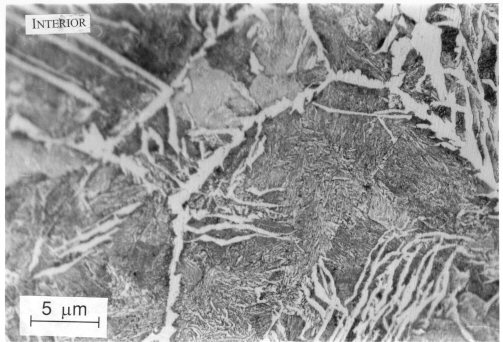
The microstructure located further into the interior of the steel core. There is a significantly smaller quantity of proeutectoid ferrite visible here compared to the boundary layer regions.
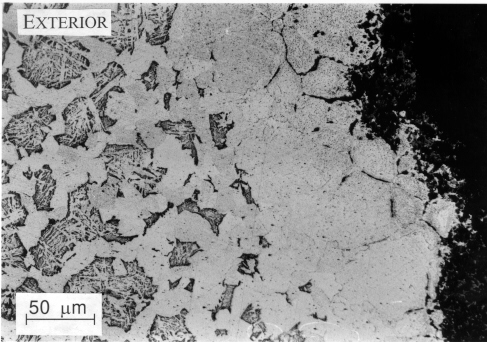
Higher magnification image highlighting the microstructure at the free surface of the steel. At this scale, it becomes clear that the top surface is almost completely denuded of carbon. The oxygen has therefore initiated the oxidation of the base iron. This internal oxidation is penetrating the prior austenite grain boundaries because they act as high-energy structural defect sites. A much higher magnification image is also accessible to examine this scale penetration path.
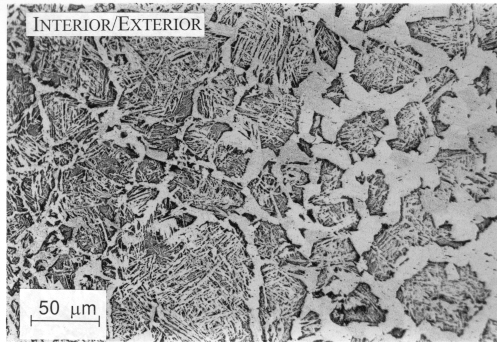
An image captured in the transition region located between the surface layer and the unaffected interior of the steel sample. The microstructure on the far left is representative of a low-carbon steel composition, whereas that on the right transitions toward a higher carbon steel signature. Thus, the allotriomorphic ferrite content decreases, to be systematically replaced by Widmanstätten ferrite spikes as the interior regions are approached.
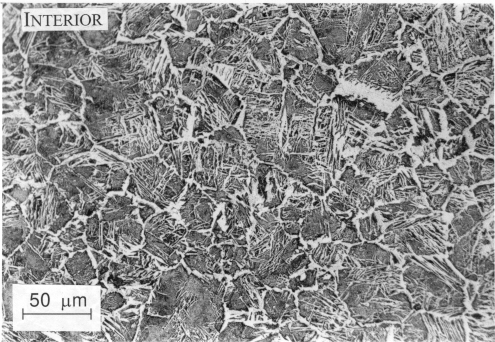
Higher magnification view of the microstructure away from the surface of the steel. The Widmanstätten ferrite morphology is more apparent at this high resolution. Notice that the steel cannot be of exactly the eutectoid composition since trace quantities of ferrite persist even within the deep regions which are safe from decarburisation. It is better described as a hypoeutectoid steel. A much higher magnification image is available to illustrate this state.
Analytical exercise
Question
Explain how decarburisation causes a variation in the microstructure in a slowly cooled eutectoid steel as a function of the distance from the exposed surface.
A $\text{Fe–0.7C wt%}$ steel is decarburised at $1200\,\text{K}$ such that a constant carbon concentration of $0.1\,\text{wt%}$ is maintained at the exposed surface. If the diffusion coefficient for carbon in austenite is $2 \times 10^{-5}\,\text{mm}^2\,\text{s}^{-1}$, how long will it take for the depth at which the concentration is $0.4\,\text{wt%}$ to become $2.5\,\text{mm}$?
How does your calculated time compare with an estimate made assuming that the diffusion distance is $2\sqrt{Dt}$? Comment on why the two results are different.
How can decarburisation be prevented in practice?
Answer
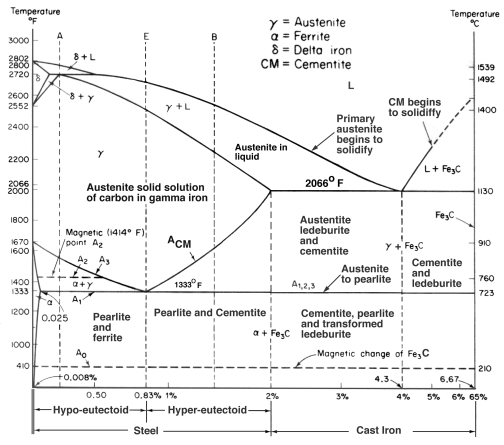
By referring to the phase diagram, it can be deduced that the surface will be rich in ferrite, and the unaffected regions away from the surface will be fully pearlitic. The intermediate regions will have a mixture of ferrite and pearlite according to the lever rule applied at the eutectoid temperature.
Using the error function solution to Fick's second law:
On the other hand, with the simplified random-walk expression:
The difference arises because this second estimate assumes a purely random walk without direction, whereas diffusion in a real concentration gradient is driven along a particular direction by the chemical potential gradient.
Decarburisation can be prevented in practice by heat treatment in an inert atmosphere, by wrapping the component in protective stainless steel foil, or by painting with an isolating barrier paint.
Technical indexes
- Aluminium alloys: age hardening etc.
- Al-Si casting alloys
- Annealing twins
- Precipitate-free zones
- Decarburisation case studies
- Recrystallisation of austenitic stainless steel
- Kirkendall effect
- Dendritic solidification
- Application of solidification theory (PDF)
- Recrystallised grain size profiles
- Cast iron metallurgy
- An example of diffusion in action